
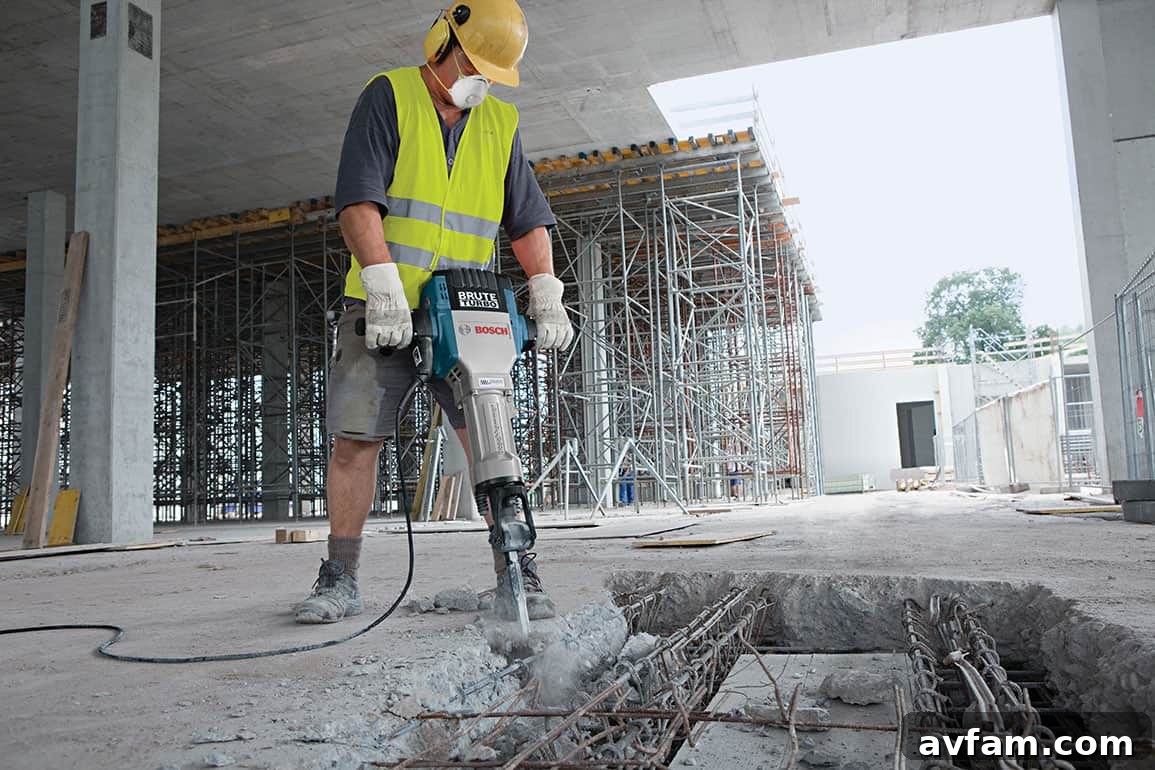
Revolutionizing Job Site Security: Bosch Introduces GPS Tool Tracking
In a groundbreaking move that promises to redefine how contractors manage and protect their valuable assets, Bosch has officially changed the tool tracking landscape. The global power tool giant has integrated sophisticated GPS tool tracking technology directly into its newest generation of breaker hammers, starting with the formidable Bosch Brute Turbo. This isn’t just an upgrade; it’s a paradigm shift in job site security and equipment management, offering an unprecedented level of control and peace of mind for professionals.
For years, Bluetooth-based tool trackers, pioneered by brands like Milwaukee with its One-Key system, have dominated the market. While these solutions offer significant advantages within a limited range, their efficacy diminishes rapidly once a tool leaves the immediate vicinity of a job site or a connected device. Bosch’s introduction of GPS tracking directly addresses this critical vulnerability, moving beyond localized monitoring to provide true, global asset visibility.
The Power of GPS: Unmatched Range and Precision
The core limitation of Bluetooth tracking has always been its range. Bluetooth operates effectively within tens of feet, relying on proximity to a smartphone or a hub device to report a tool’s location. This means that if a tool is misplaced, forgotten, or worse, stolen from a job site, managers often have no recourse once it’s out of Bluetooth range. This leads to costly replacements, project delays, and significant frustration.
GPS tool tracking completely eliminates these geographical constraints. By leveraging a global network of satellites, GPS-enabled tools can transmit their precise location data from virtually anywhere on the planet where a cellular or satellite signal is available. This means you can:
- Track Every Movement: Monitor the real-time location of your tools, understanding their journey from the warehouse to the job site and beyond.
- Enhance Theft Recovery: In the unfortunate event of theft, GPS provides immediate, actionable intelligence for law enforcement, dramatically increasing the chances of recovery.
- Implement Geofencing: Set up virtual boundaries around job sites or storage areas. Receive instant alerts if a tool enters or exits these designated zones, ensuring equipment remains where it should be.
- Improve Asset Utilization: Understand where tools are being used, identify idle equipment, and optimize distribution across multiple projects.
This level of pervasive tracking transforms tool management from a reactive, often futile exercise into a proactive, highly effective strategy. For construction companies and independent contractors alike, the implications for cost savings, efficiency gains, and heightened security are profound.
Bosch’s Bold Leap: Setting a New Industry Standard
Bosch has not traditionally been a frontrunner in the tool tracking space, often observing from the sidelines while competitors innovated with Bluetooth solutions. However, their strategic entry with GPS tracking positions them as a vanguard in an entirely new dimension of tool intelligence. Their decision to launch this technology with a high-value, heavy-duty tool like the Brute Turbo breaker hammer underscores the seriousness of their commitment and the immediate value proposition for premium equipment.
What’s particularly impressive is that Bosch isn’t limiting this innovation to newly purchased tools. They are also offering GPS tracking as a retrofit option for existing breaker hammer models. This forward-thinking approach ensures that current Bosch customers can upgrade their valuable assets without needing to replace entire fleets, offering a seamless and cost-effective transition to enhanced security.
While Bosch is making waves with GPS, they are also preparing to enter the Bluetooth tool management arena later this year with “Bluehound.” This system is anticipated to be a direct competitor to Milwaukee’s well-established One-Key platform, offering inventory management, tool customization, and usage data within Bluetooth’s operational range. This dual strategy suggests Bosch is aiming to provide a comprehensive, tiered solution for tool tracking, catering to different needs and budgets, from localized Bluetooth oversight to global GPS surveillance.
GPS vs. Bluetooth: A Detailed Comparison for the Modern Job Site
Understanding the fundamental differences between GPS and Bluetooth tracking is crucial for making informed decisions about tool management. Both technologies serve valuable purposes, but their strengths lie in distinct applications.
Bluetooth Tool Tracking
- Range: Limited to approximately 100-300 feet (30-90 meters), depending on line of sight and environment.
- Connectivity: Relies on proximity to a connected smartphone or a Bluetooth gateway device.
- Primary Use: Inventory management within a confined space, last-seen location updates, basic tool customization, and usage monitoring on an active job site.
- Power Consumption: Generally low, allowing for extended battery life on small trackers.
- Cost: Trackers are typically inexpensive, often integrated into tools or available as small, attachable tags.
- Limitations: Ineffective for tracking tools that leave the local network or are stolen from the job site. No real-time tracking over long distances.
GPS Tool Tracking
- Range: Global, wherever cellular or satellite signal is available.
- Connectivity: Utilizes satellite networks for location and cellular networks for data transmission.
- Primary Use: Real-time location tracking, theft recovery, geofencing, long-distance asset management, and cross-site visibility.
- Power Consumption: Higher than Bluetooth, requiring more robust power sources or larger batteries.
- Cost: Typically higher, often involving a subscription service for data transmission and platform access.
- Advantages: Unparalleled security for high-value assets, definitive proof of location for recovery, comprehensive oversight of mobile equipment.
While Bluetooth systems like Milwaukee’s One-Key and the upcoming Bosch Bluehound excel at managing tools within an active work zone, GPS tracking fills the critical gap of securing tools once they leave that immediate environment. For expensive equipment that is prone to theft or frequently moved between sites, GPS offers an undeniable advantage.
The Future is Connected: Expanding GPS Across the Bosch Lineup
The introduction of GPS tracking on the Brute Turbo breaker hammer is almost certainly just the beginning. The industry anticipates that this advanced technology will rapidly trickle down to the rest of Bosch’s extensive tool lineup. We expect to see GPS capabilities integrated into other high-value assets, including:
- Heavy-duty corded and cordless tools (e.g., rotary hammers, large angle grinders, demolition hammers).
- High-performance 18V and 12V cordless tools, especially those frequently used on diverse job sites or prone to being misplaced.
- Larger measurement tools and job site equipment (e.g., lasers, generators, air compressors).
Bosch appears to have a significant lead in this burgeoning market segment. As the technology matures and becomes more cost-effective, integrating GPS capabilities directly into the manufacturing process will become standard practice, much like how Bluetooth connectivity has become prevalent in recent years.
Beyond Tracking: The Ecosystem of the Smart Job Site
The implications of widespread GPS tool tracking extend far beyond simple location monitoring. This technology is a foundational element for the fully connected, “smart” job site of the future:
- Enhanced Inventory Management: Automated tracking systems can provide real-time inventory counts, reducing manual checks and errors.
- Preventative Maintenance: By tracking usage and location, tools can be brought in for maintenance based on actual wear and tear, rather than arbitrary schedules.
- Improved Compliance: Ensuring that the right tools are on site for specific tasks, and that they comply with safety regulations.
- Data-Driven Decision Making: Aggregated data on tool usage, location, and maintenance can inform purchasing decisions, project planning, and operational efficiencies.
This integration of sophisticated hardware with intelligent software platforms will empower construction businesses to operate with unprecedented levels of efficiency, security, and insight. The reduction in tool loss, coupled with optimized asset utilization, will lead to significant cost savings and improved profitability.
Conclusion: Bosch Paves the Way for a More Secure Future
Bosch’s introduction of GPS tool tracking is more than just a new feature; it’s a strategic move that addresses a critical and long-standing pain point for contractors: tool theft and loss. By offering real-time, global tracking capabilities, Bosch is not only enhancing the security of high-value assets but also laying the groundwork for a truly intelligent and connected job site.
We eagerly anticipate the widespread adoption of this technology across Bosch’s product lines and, indeed, throughout the entire power tool industry. As companies continue to invest in digital solutions for construction, GPS tool tracking will undoubtedly become an essential component, ensuring that valuable equipment is always accounted for, always secure, and always ready for the next job. Bosch has taken a monumental step forward, and the benefits for professionals are clear: greater security, improved efficiency, and ultimate peace of mind.