
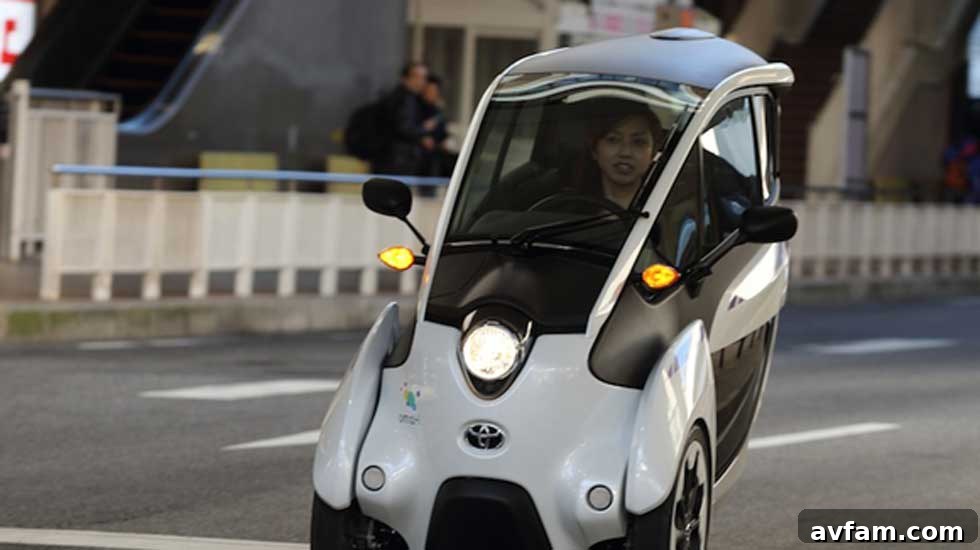
Revolutionizing Urban Commutes: Exploring the Innovative Toyota i-ROAD
At the heart of automotive enthusiasm lies a deep appreciation for anything with wheels. From the robust utility of tractors to the commanding presence of trucks, and even the simple efficiency of a lawnmower, vehicles shape our daily lives and fuel our sense of freedom. Yet, every so often, an innovation emerges that challenges our preconceptions and points towards a radically different future. The Toyota i-ROAD is precisely such a concept – a groundbreaking personal mobility vehicle that is poised to redefine urban commuting and how we navigate our increasingly crowded cities.
The i-ROAD isn’t just another electric car; it’s a revolutionary blend of motorcycle agility and car-like stability, designed from the ground up to tackle the unique challenges of urban environments. Its compact size and electric powertrain represent a thoughtful response to issues like traffic congestion, parking scarcity, and air pollution, offering a glimpse into a more sustainable and efficient mode of personal transportation. As urban populations continue to swell and city infrastructure struggles to keep pace, vehicles like the i-ROAD become not just desirable, but essential.
Introducing the Toyota i-ROAD: A Leap in Personal Mobility
What exactly makes the Toyota i-ROAD so unique? Imagine a sleek, three-wheeled electric vehicle that combines the slim profile of a scooter with the enclosed comfort and safety of a small car. This innovative design is central to its appeal. Measuring just 2345mm long, 870mm wide, and 1455mm high, the i-ROAD is incredibly nimble, capable of weaving through traffic and parking in spaces that would be impossible for conventional cars. Its electric motor provides silent, emission-free operation, making it an ideal choice for environmentally conscious city dwellers.
However, the true marvel of the i-ROAD lies in its “Active Lean” technology. Unlike a traditional car that uses suspension to absorb bumps, or a motorcycle that requires the rider to lean manually, the i-ROAD automatically leans into turns. This sophisticated system uses an onboard computer to calculate the optimal lean angle based on speed, steering input, and gyro-sensor data, then actively adjusts the vehicle’s posture via a linking mechanism between the front two wheels. This intelligent leaning system ensures stability and a smooth, engaging driving experience, making it intuitive even for those unfamiliar with two-wheeled vehicles. Drivers report quickly adapting to its handling, finding it both fun and incredibly practical.
Addressing the Urban Commute Nightmare: Los Angeles as a Case Study
The challenges of urban commuting are starkly evident in sprawling metropolises like Los Angeles. Here, the daily drive is often described as a nightmare, a soul-crushing ordeal that impacts everything from job satisfaction to personal well-being. It’s common for job interviews to delve into commute details, as even ideal candidates might decline or quit positions due to the sheer misery of navigating LA traffic. The average Los Angeles commuter spends an astronomical amount of time stuck in congestion each year, converting precious hours into frustrating delays.
Beyond the gridlock, parking presents another significant hurdle. Arriving at a destination often means factoring in an additional 20 minutes (or more) simply to circle blocks in a desperate search for an open spot. Parking garages are expensive, street parking is scarce, and the overall experience adds layers of stress to an already taxing journey. This inefficiency isn’t just about personal inconvenience; it represents a massive economic and environmental drain on the city.
In this context, the Toyota i-ROAD emerges as a compelling solution. Its ultra-compact footprint means it occupies significantly less road space than a traditional car, potentially freeing up critical lanes and reducing congestion. More importantly, its diminutive size vastly simplifies parking, allowing multiple i-ROADs to fit into a single conventional parking space. This isn’t just theoretical; it promises tangible benefits by alleviating one of the most persistent pains of urban driving. Furthermore, as an all-electric vehicle, the i-ROAD contributes directly to improved air quality, a crucial concern for cities battling smog and pollution. Imagine a significant portion of a city’s vehicles being zero-emission – the impact on public health and the environment would be transformative.
Real-World Trials and Global Adaptation
Toyota isn’t just presenting the i-ROAD as a concept; they’re actively testing its viability and public acceptance in real-world scenarios. A recent live test version conducted in Toyota City, Japan, yielded promising results. Despite its futuristic appearance initially drawing some curious glances, participants quickly became accustomed to the i-ROAD’s unique handling and steering characteristics. The ease of parking and charging were immediately recognized as major advantages, validating Toyota’s vision for practical urban mobility. These trials are vital for gathering user feedback, refining the technology, and understanding how best to integrate such vehicles into existing urban ecosystems.
The enthusiasm for the i-ROAD extends beyond Japan. The next significant test drive initiative took place in Grenoble, France, as part of the “Citélib by Ha:mo” project. This ambitious program integrated the i-ROAD into a comprehensive electric car-sharing service, demonstrating its potential as a “last-mile” solution. Users could pick up an i-ROAD from a charging station and drop it off at another, seamlessly connecting with public transportation networks. This kind of integrated approach is key to the i-ROAD’s success, positioning it not as a replacement for public transit, but as an enhancement that solves the common challenge of getting from a bus stop or train station to a final destination efficiently.
These international trials underscore Toyota’s commitment to developing mobility solutions that are adaptable to diverse urban landscapes and user needs. They are not merely testing a vehicle; they are exploring a new paradigm for urban living, one where personal mobility is convenient, sustainable, and less stressful.
The Broader Impact: Benefits Beyond the Driver
The advantages of widespread adoption of vehicles like the Toyota i-ROAD extend far beyond individual drivers. From a societal perspective, the benefits are substantial:
- Reduced Congestion: A significant portion of urban traffic is caused by single-occupant vehicles. The i-ROAD’s small size means more vehicles can occupy the same road space, or existing space can be utilized more efficiently.
- Alleviated Parking Pressure: The ability to park multiple i-ROADs in a single conventional parking spot dramatically increases parking capacity in dense urban areas, reducing the time and frustration associated with finding a space.
- Improved Air Quality: As an all-electric vehicle, the i-ROAD produces zero tailpipe emissions, directly contributing to cleaner urban air and mitigating health issues associated with vehicle pollution. This aligns with global efforts to combat climate change and promote sustainable living.
- Enhanced Last-Mile Connectivity: Integrated into ride-sharing or public transport networks, the i-ROAD fills a critical gap, making public transit more appealing and accessible by solving the final leg of a journey.
- Quiet Cities: Electric vehicles are significantly quieter than their internal combustion engine counterparts, leading to a reduction in urban noise pollution, which has documented health benefits.
- Technological Advancement: The i-ROAD is a testament to auto manufacturers pushing the limits of design and technology. This innovation not only solves immediate problems but also drives progress across various segments of society, from materials science to software engineering.
Toyota’s Vision for Future Mobility and Innovation
It’s inspiring to witness auto manufacturers like Toyota continually push the boundaries of vehicle design and technology. The i-ROAD is a clear demonstration of their forward-thinking approach, moving beyond traditional automotive models to address the evolving needs of a rapidly urbanizing world. This commitment to innovation is not just about creating new vehicles; it’s about envisioning and building a better, more sustainable future for mobility.
The i-ROAD embodies a broader trend towards smart cities and sustainable transport systems. As global populations continue to migrate to urban centers, the demand for efficient, eco-friendly, and enjoyable ways to move around will only intensify. Toyota, with its long history of innovation and its clear focus on sustainability, is well-positioned to lead this transformation. The i-ROAD is more than just a vehicle; it’s a statement about the potential for clever design and advanced technology to solve complex problems and improve the quality of urban life.
The enthusiasm surrounding the i-ROAD is palpable, and for good reason. It offers a tangible solution to some of the most persistent and frustrating aspects of city living, wrapped in an innovative and engaging package. Whether you’re intrigued by its unique leaning mechanism, its environmental benefits, or its promise of hassle-free urban commutes, the i-ROAD represents an exciting direction for personal mobility.
If you find yourself in Grenoble, France, or at future demonstration events, be sure to give a wave to this groundbreaking vehicle. To delve deeper into the technology and vision behind the Toyota i-ROAD, we encourage you to visit their official website to learn more.
This is a sponsored conversation written by me on behalf of Toyota. The opinions and text are all mine.