
Mastering OSHA Silica Dust Regulations: A Comprehensive Guide for Construction Safety
The construction industry constantly evolves, with safety regulations playing a critical role in protecting workers. Among the most significant advancements in occupational health over recent years are the stringent OSHA regulations concerning respirable crystalline silica dust. While the full enforcement for construction began on September 23, 2017, the imperative for contractors and manufacturers to comply remains as vital as ever. These regulations aim to drastically reduce worker exposure to silica dust, a pervasive and dangerous byproduct of common construction tasks involving concrete, masonry, and other silica-containing materials. Understanding and implementing these rules is not just a legal obligation but a cornerstone of a healthy and productive work environment.
To shed light on this critical topic, industry leaders like Bosch Power Tools have partnered with experts such as Joe Nasvik, the esteemed former 12-year editor of Concrete Construction Magazine. Their collaborative insights help professionals navigate the complexities of silica dust control, ensuring that every job site prioritizes safety without compromising efficiency. This comprehensive guide delves into the specifics of the new regulations, the inherent risks of silica exposure, and the innovative solutions available to maintain compliance.
What Are the OSHA Silica Dust Regulations and Why Are They Crucial?
The U.S. Department of Labor’s ruling on respirable crystalline silica dust was a long-awaited and necessary step towards better protecting construction workers. Before these updated regulations, millions of workers faced exposure levels that, while compliant with older rules, were still proven harmful over time. The updated regulation substantially reduced the Permissible Exposure Limit (PEL) for workers in the construction industry. OSHA now enforces a reduction in the amount of silica that workers can be exposed to over an eight-hour day from 250 micrograms per cubic meter of air (µg/m³) to a significantly stricter 50 µg/m³.
This five-fold reduction underscores the severity of the health risks associated with silica dust. The scientific consensus clearly demonstrates that prolonged exposure to even seemingly low levels of respirable crystalline silica can lead to debilitating and often fatal diseases. Consequently, this updated standard is a fundamental shift, moving from an outdated understanding of risk to one grounded in modern occupational health science.
Understanding Respirable Crystalline Silica: A Silent Threat
To grasp the importance of these regulations, one must first understand what silica is and why it poses such a threat. Silicon (Si) is the second most common element on Earth, making up 28 percent of the planet’s crust. It frequently combines with oxygen to form quartz (SiO₂), commonly known as sand. Silica is a fundamental component in a wide range of the Earth’s rocks, including granite, sandstone, and slate, and is therefore present in concrete, brick, and mortar.
The concern arises when these materials are cut, ground, drilled, or crushed, releasing microscopic particles of crystalline silica into the air. These particles are incredibly small, often 100 times smaller than a grain of sand, making them invisible to the naked eye. This is what’s known as “respirable crystalline silica.” When inhaled, these minuscule particles can bypass the body’s natural defenses and embed deep within the lungs, causing severe and irreversible damage over time. It’s estimated by OSHA that approximately 2.3 million U.S. workers are exposed to respirable silica dust at work each year, highlighting the widespread nature of this occupational hazard.
The Life-Threatening Risks of Inhaling Silica Dust
Inhalation of respirable crystalline silica is indeed a serious threat to life and long-term health. The primary disease associated with silica exposure is silicosis, an incurable lung disease that can be debilitating and fatal. Silicosis causes permanent scarring of the lungs, leading to shortness of breath, severe coughing, and fatigue. In severe cases, it can lead to respiratory failure and death.
Beyond silicosis, exposure to respirable crystalline silica is also linked to other severe health problems, including:
- Lung Cancer: OSHA and other health organizations recognize crystalline silica as a human carcinogen.
- Chronic Obstructive Pulmonary Disease (COPD): A group of lung diseases that block airflow and make breathing difficult.
- Kidney Disease: Studies have shown a link between silica exposure and increased risk of kidney disease.
- Autoimmune Diseases: Including rheumatoid arthritis and lupus.
Given the irreversible nature of these diseases, prevention through strict exposure control is the only effective solution.
The Evolution of OSHA Silica Regulations: From Outdated to Rigorous
While OSHA did set limits on respirable crystalline silica dust exposure in 1971, shortly after the agency was created, these regulations were largely based on research from the 1960s and earlier. Over time, it became clear that these initial limits did not adequately protect workers. The old limits were often expressed as complex formulas, making them difficult for many in the industry to understand and consistently apply. This ambiguity, combined with increasing scientific evidence of silica’s dangers, highlighted the urgent need for clearer, more protective standards.
The new rule, fully enforced for construction since September 23, 2017, dramatically simplifies and strengthens these protections. It establishes a clear, unified Permissible Exposure Limit (PEL) of 50 μg/m³, averaged over an eight-hour shift, for all industries covered by the rule. To put this into perspective, 50 μg/m³ is roughly 1/20th the size of a single grain of table salt when considering mass concentration, emphasizing the microscopic scale of the particles that must be controlled. This clear, measurable standard makes compliance more straightforward and more effective in safeguarding worker health.
Practical Steps for Contractors and Jobsite Safety
With the updated regulations firmly in place, contractors and those working on jobsites must adopt proactive measures to minimize silica dust exposure. OSHA mandates a hierarchical approach to control hazards, prioritizing methods that eliminate or reduce exposure at the source. This hierarchy emphasizes:
1. Engineering Controls: The First Line of Defense
Employers are primarily required to use “engineering controls” to limit worker exposure. These are methods designed to reduce or remove the hazard at its source, without requiring individual worker action every time. Key engineering controls include:
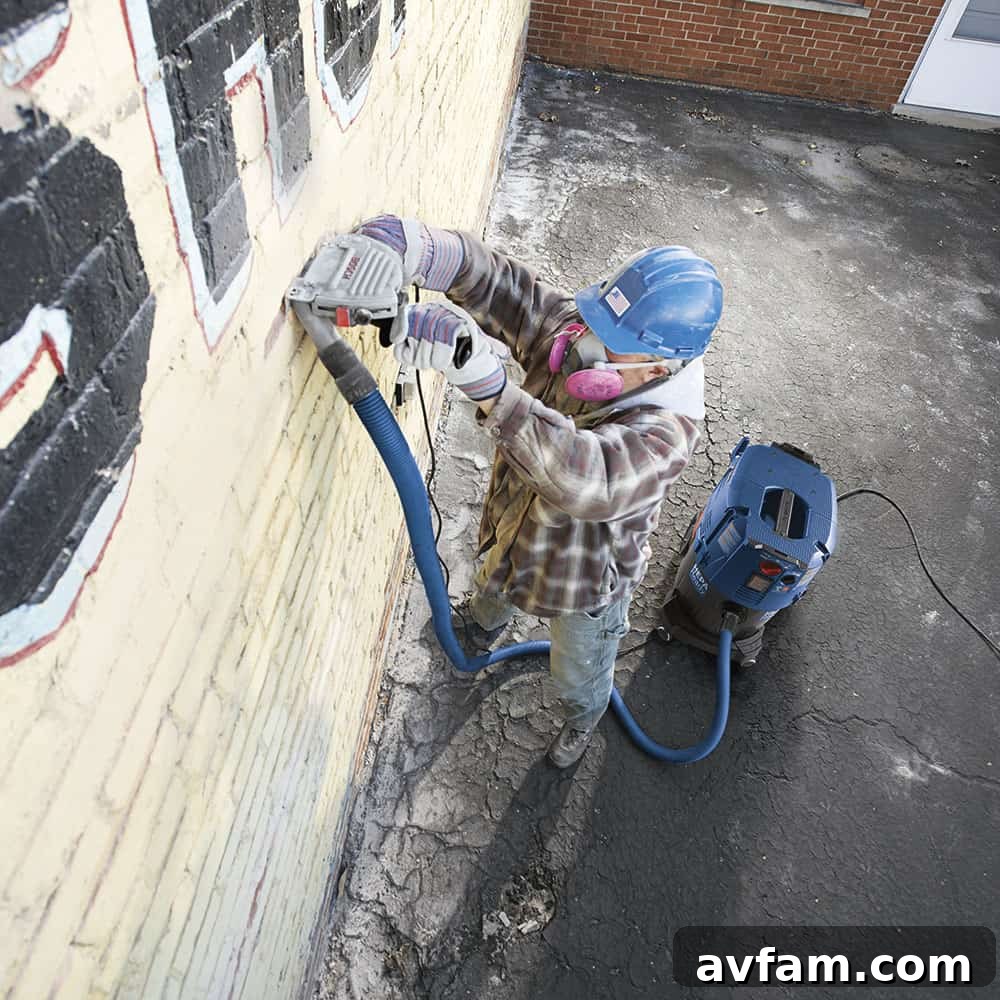
- Vacuum Dust Collection Systems: Attaching specialized vacuums directly to power tools (like grinders, saws, and drills) to capture dust as it’s generated.
- Water-Delivery Systems (Wet Methods): Applying water to the point of dust generation to keep particles from becoming airborne. This is commonly used for cutting, sawing, and grinding concrete or masonry.
- Enclosed Cabs: For heavy equipment operations, providing enclosed cabs with filtered air to protect operators.
These systems are crucial because they prevent silica dust from becoming airborne in the first place, thus protecting not only the operator but also other workers in the vicinity.
2. Work Practice Controls
These are changes in the way tasks are performed to reduce exposure. Examples include:
- Designated Areas: Establishing restricted access zones for silica-generating tasks.
- Hygiene Practices: Ensuring workers have access to washing facilities and discouraging dry sweeping or compressed air for cleaning silica dust.
- Maintenance and Housekeeping: Regularly cleaning work areas using HEPA-filtered vacuums or wet methods.
3. Respiratory Protection: A Last Resort, When Necessary
While engineering and work practice controls are preferred, respirators must be used when these controls cannot reduce exposure to or below the PEL. This includes during specific tasks, or when engineering controls are being set up or are temporarily unavailable. Employers must:
- Provide appropriate respirators.
- Ensure workers are medically cleared, fit-tested, and trained on proper use, maintenance, and storage of respirators.
Specified exposure control methods are explicitly referenced in OSHA Table 1, a cornerstone of compliance for the construction industry.
Navigating OSHA Table 1: Your Guide to Compliance
At the heart of the new silica dust control regulations for the construction industry is OSHA Table 1, “Specified Exposure Control Methods When Working With Materials Containing Crystalline Silica.” This table is an invaluable resource, simplifying compliance by matching common construction tasks with effective dust control methods. It essentially provides a roadmap for ensuring safety without requiring complex air monitoring in most situations.
Table 1 is structured into three clear columns:
- Task or Equipment Being Used: This column lists common construction activities that generate silica dust, such as cutting concrete, grinding, drilling, tuckpointing, and using jackhammers.
- Method for Controlling Dust: This column specifies the required engineering controls (e.g., integrated water delivery, dust collection systems with specific CFM ratings) and work practice controls for each task.
- Required Respiratory Protection and Minimum Assigned Protection Factor (APF): This column indicates what type of respiratory protection, if any, is needed when performing the task, specifying the minimum APF (a measure of how much protection a respirator provides).
By simply finding a work activity on the table, contractors can easily determine the necessary steps to ensure compliance, making it a powerful tool for jobsite planning and execution. Adhering to Table 1 helps companies meet OSHA standards, protect their workers, and avoid potential penalties.
Innovative Solutions from Manufacturers: Bosch PRO+GUARD™
The best way to control respirable crystalline silica dust is to capture and remove it at the source, preventing it from ever becoming airborne. Power tool manufacturers have responded to the new OSHA requirements by developing sophisticated products and systems designed to achieve precisely this. Bosch, for example, has introduced its PRO+GUARD™ dust solutions lineup – a comprehensive suite of tools and accessories engineered to help companies and their workers remain compliant.
The focus of these innovations is on developing superior dust extractors and highly effective attachments, such as shrouds, that integrate seamlessly with power tools. These solutions are designed to encapsulate the point of dust generation, channeling airborne particles directly into a powerful vacuum system. Bosch-engineered dust control solutions, including their PRO+GUARD™ line, are developed with the explicit goal of helping users achieve jobsite air quality that meets and often exceeds OSHA regulations.
Capturing Dust: Tools and Techniques for Concrete Applications
For most concrete applications, the strategy revolves around integrated systems that capture dust before it can become a hazard. This involves:
- Tool Attachments: Shrouds for grinders, cutting tools, and dust extraction attachments that fit around chipping hammer bits and hammer drill bits are essential. These attachments create a confined space around the cutting or drilling point, allowing a vacuum to efficiently pull dust away.
- Integrated Vacuum Systems: These attachments are connected to specialized vacuums designed for fine particulate matter, forming a closed system that prevents particles from becoming airborne.
A particularly innovative component for drilling concrete is the use of dust extraction bits. Bits like Bosch Speed Clean™ are built around an internal dust channel. This channel is milled to allow dust created at the bottom of a hole to be sucked directly through the center of the bit and into a connected dust extractor. This provides superior dust reduction at the point of generation and helps keep the hole clean for optimal anchoring. These bits are both OSHA and code approved for use with epoxy anchors, streamlining the process of complying with multiple standards simultaneously. Furthermore, employers must establish processes that minimize the release of respirable silica dust into the environment during the maintenance of tools and the handling of employee work clothes, such as providing designated areas for changing and proper disposal or cleaning of contaminated clothing.
The Critical Role of Specialized Vacuums for Silica Dust
It’s a common misconception that any shop vacuum will suffice for silica dust collection. This is emphatically not the case. Specialized vacuums are required, equipped with specific features to effectively and safely handle respirable crystalline silica. These include:
- High CFM Suction: The vacuum needs to have a high amount of Cubic Feet per Minute (CFM) suction, typically +150 CFM, to ensure powerful and consistent airflow capable of capturing fine dust particles.
- Automated Filter Cleaning Feature: Fine dust particles quickly clog filters, leading to a rapid loss of suction. Vacuums for concrete/fine dust collection must provide a built-in filter cleaning feature. Many advanced models, like Bosch’s, automatically clean the filter every 15 seconds with reverse blasts of air to ensure the filter maintains its utility and the vacuum sustains optimal performance. Other manufacturers employ different filter-cleaning methods, but the principle of continuous or automated cleaning is vital.
- HEPA Compliance: Crucially, these vacuums must be HEPA compliant. To qualify as HEPA (High-Efficiency Particulate Air) according to U.S. government standards, an air filter must remove 99.97% of particles with a size of 0.3 microns or less. Respirable crystalline silica particles are often within this dangerous size range. When looking for a HEPA vacuum filter that meets OSHA requirements, it must explicitly state on the filter or product documentation that it will remove particles three microns in size or less. While HEPA filters are expensive, they are absolutely necessary for effectively capturing these microscopic and hazardous particles.
As a filter removes smaller and smaller particles, the vacuum’s power and airflow (measured in CFM) must be robust enough to maintain effective suction. This combination of powerful suction, efficient filtration, and active filter cleaning is non-negotiable for silica dust control.
Maintaining Specialty Filters: A Critical Detail
Proper maintenance of specialty filters is paramount for ensuring the vacuum functions correctly and continuously meets OSHA requirements. Vacuum filters for silica dust collection must maintain their efficacy at all times. As mentioned, features like automatic filter cleaning are designed to keep the filter pores clear, preventing them from becoming clogged by fine concrete dust.
A critical rule to remember: filters should NEVER be washed out, especially when concrete dust is involved. Water causes concrete dust to harden within the microscopic pores of the filter material, rendering the filter completely useless and ineffective at capturing harmful particles. Instead, follow manufacturer guidelines for filter maintenance, which typically involve tapping, shaking, or using the integrated automated cleaning mechanisms. Regular inspection and timely replacement of filters are also essential to maintain optimal performance and compliance.
Impact on Productivity: Safety as an Enhancer, Not a Hindrance
The implementation of new regulations is sometimes met with concerns about their impact on productivity and project timelines. While initial adjustments are always required, the OSHA silica dust regulations, in the long run, can actually enhance productivity and operational efficiency.
Firstly, the entire effort ties back to keeping people safe. There is no cure for silicosis or other silica-related diseases; therefore, worker health fundamentally depends on limiting exposure. A healthy workforce is a more productive workforce. Reduced exposure to silica dust means fewer instances of illness, less absenteeism, and a more engaged and capable team. Employees who feel safe and protected are often more focused and perform better.
Secondly, the respirable silica dust regulations require the use of already accepted and often highly efficient control methods. Integrating dust collection systems, wet methods, and specialized tools into standard operating procedures can lead to cleaner jobsites, better visibility, and reduced cleanup time. Tools equipped with effective dust extraction can sometimes even work more efficiently as they aren’t bogged down by accumulated debris. Compliance, rather than being a burden, can be seen as an investment in long-term operational excellence and worker well-being.
Conclusion: Prioritizing Health and Compliance on Every Jobsite
The OSHA silica dust regulations represent a crucial leap forward in protecting the health of construction workers. By significantly reducing the permissible exposure limit and providing clear guidelines through resources like OSHA Table 1, the industry is now better equipped to tackle the silent threat of respirable crystalline silica. Manufacturers like Bosch have risen to the challenge, developing innovative tools and systems that make compliance more achievable and less disruptive.
For contractors and workers, understanding these regulations, investing in the right engineering controls, and consistently implementing safe work practices are non-negotiable. While the initial enforcement date may be in the past, the commitment to vigilance and continuous improvement in silica dust control must remain at the forefront of every construction project. Prioritizing worker health not only meets legal obligations but fosters a safer, more productive, and more sustainable future for the entire industry.