
In an increasingly digital world, the profound value of hands-on learning often gets overlooked. Yet, the experience of raising children who can confidently tackle challenges with their own hands is incredibly rewarding. Whether it’s designing and building a sturdy birdhouse, mastering the art of baking a perfect loaf of bread, or learning to manage a simple household budget, these practical, tactile experiences create lasting impressions and instill a sense of accomplishment that no amount of theoretical knowledge or worksheet exercises can replicate. For modern families dedicated to nurturing capable, curious, and resilient adults, establishing a dedicated, practical space for exploration and skill development is arguably one of the most impactful investments you can make in your children’s future.
The concept of a ‘family workshop’ might conjure images of elaborate garage studios or costly home renovations, but this needn’t be the case. At its core, a family workshop is simply an intentional environment—a designated zone within your home—where children are actively encouraged to experiment, innovate, fail, tinker, and build. This space thrives on the unwavering support and guidance of the adults around them, fostering a safe haven for growth without the pressure of perfection. It’s a dynamic hub for creativity, problem-solving, and the cultivation of essential life skills that extend far beyond the immediate project at hand.

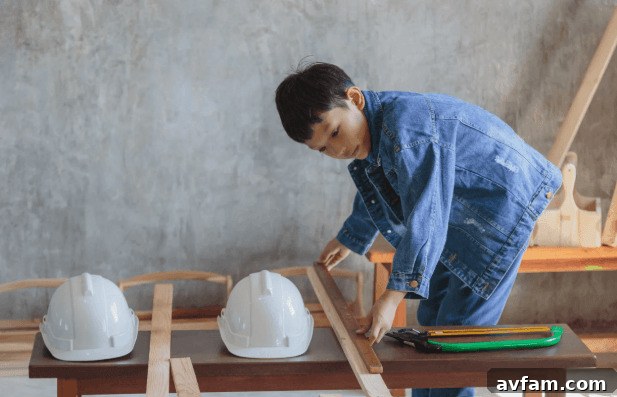
Image by Gianluca Pantaleo on Canva
Cultivating a Growth Mindset for Your Family Workshop
Before you purchase a single tool or reorganize a single shelf, the foundational element for a successful family workshop is establishing the right collective attitude. A thriving workshop culture is one where mistakes are not only anticipated but embraced as vital learning opportunities. It’s a space where messes are seen as manageable byproducts of creative exploration, and where the process—the effort, the persistence, and the critical thinking involved—matters infinitely more than the final outcome. This mindset shifts the focus from achieving perfection to celebrating genuine engagement and incremental progress.
Embracing Experimentation and Resilience
This means allowing your eight-year-old the freedom to attempt wiring a simple electrical circuit, even if it requires four or five frustrating tries before the light finally flickers on. It involves empowering your teenager to plan a complex woodworking project entirely from scratch, rather than merely following the pre-designed steps of a kit. The true educational value lies in the intricate layers of thinking, strategizing, and problem-solving that unfold throughout the journey. When children genuinely understand that the workshop is a safe zone for experimentation and calculated risks, they become significantly more willing to tackle challenges that initially seem daunting. This cultivated confidence isn’t confined to the workbench; it becomes a fundamental aspect of their character, influencing their approach to academics, social interactions, and future aspirations.
The Role of Adults: Facilitators, Not Fixers
In this environment, adults act as facilitators and mentors rather than direct supervisors or “fixers.” Your role is to guide, ask open-ended questions, and offer support when genuinely needed, allowing children to grapple with problems and discover solutions independently. This approach fosters self-reliance, critical thinking, and a deeper understanding of cause and effect. It teaches patience, perseverance, and the invaluable lesson that competence is built over time through effort and repeated attempts, not acquired instantly or handed out automatically.
Designing an Inspiring and Functional Family Workshop Space
Creating an effective workshop doesn’t demand vast amounts of space or a hefty budget. A designated corner of the garage, a sturdy folding table in the basement, a well-organized shelf unit in a spare room, or even a section of the kitchen can all serve as the perfectly adequate foundation for a functional and inviting workshop. What truly matters more than the square footage is intelligent organization, thoughtful accessibility, and an atmosphere that encourages active participation.
Organization and Accessibility: Tools at Their Fingertips
Key to a child-friendly workshop is ensuring that tools and materials are stored at a height easily reachable by children. Clear, intuitive labeling of bins, drawers, and shelves is crucial, empowering kids to find what they need and, just as importantly, return items to their proper place without constant adult supervision. A pegboard mounted on the wall is an exceptionally practical and cost-effective investment. It keeps tools visible, neatly organized, and minimizes clutter. Moreover, it subtly teaches children a fundamental aspect of craftsmanship: the importance of caring for and respecting their equipment. Consider color-coding tool handles or storage bins for younger children to further aid in organization and clean-up.
Safety First: Age-Appropriate Tools and Materials
For younger children, start with low-risk, easily manageable materials. Think cardboard, craft foam, safe modeling clay, blunt-tip scissors, simple hand tools like plastic screwdrivers, and non-toxic adhesives. As their fine motor skills, coordination, and maturity develop, you can progressively introduce more complex tools and materials. This gradual introduction ensures safety while preventing overwhelm. The physical environment itself should clearly signal that this is their space—a place where their ideas are valued, and their contributions are central, rather than merely an area where adults occasionally permit them to “help.” Incorporate child-height workbenches or adjustable tables to accommodate growing bodies and evolving projects. Ensure good lighting and adequate ventilation, especially when working with glues, paints, or sawdust.
Making the Space Inviting and Flexible
An inspiring workshop also includes elements that spark imagination. Consider a chalkboard or whiteboard for sketching ideas, a “gallery wall” to display finished projects, or a small library of how-to books and inspirational guides. The space should be flexible enough to accommodate different types of projects – from messy painting to intricate model building – and easily reconfigurable as your children’s interests evolve. Remember, a well-designed workshop isn’t just about tools; it’s about fostering an environment where curiosity can flourish without inhibition.
Connecting Hands-On Work to Real-World Concepts
A family workshop transcends mere craft-making when it effectively bridges the tangible with the conceptual. This is where hands-on learning transforms into truly profound education. For instance, constructing a small raised garden bed is not only a practical carpentry project involving measuring, cutting, and assembly, but it also becomes a powerful, real-world lesson in mathematics (measurement, geometry), planning, biology (plant cycles, soil health), environmental science, and the virtue of patience. Similarly, cooking a meal from scratch introduces practical applications of fractions, chemistry, sequential thinking, and an understanding of nutrition.
Project-Based Learning and Academic Integration
This is precisely where intentional curriculum integration or resource support can profoundly enhance the learning experience. Families who utilize educational platforms like The Tuttle Twins homeschool hub, for example, often discover an easier pathway to connect project-based learning to broader academic and societal ideas. Their resources can provide a framework to link a child’s hands-on efforts to fundamental principles in economics, civics, entrepreneurship, and personal responsibility. This integration provides children with a vital context, illustrating why their practical work holds significant relevance and value in the wider world beyond their immediate project.
When a child not only builds something tangible but then understands the underlying economic principles—such as why people innovate, how trade creates value, or the importance of collaboration in a marketplace—the workshop is elevated. It transforms from a simple craft area into a powerful launching pad for genuine critical thinking, analytical reasoning, and a holistic understanding of how the world functions. They begin to see the interconnectedness of skills, knowledge, and real-world impact.

Dynamic Projects That Evolve With Your Child’s Growth
One of the most compelling advantages of establishing a family workshop is its inherent scalability and adaptability. The very same physical space that effectively serves a six-year-old learning the safe handling of scissors and glue can seamlessly transition to accommodate a sixteen-year-old delving into basic electronics, home repair, or even entrepreneurial endeavors. This evolving capacity ensures that the workshop remains a relevant and engaging learning environment throughout your children’s developmental stages.
Here are some project categories designed to grow in complexity and skill requirement, suitable for rotating through at different ages and stages:
- Elementary Years (Ages 5-10): Focus on foundational skills and supervised exploration. Projects might include simple woodworking tasks like assembling pre-cut birdhouses, crafting basic picture frames, or designing small toy cars. Introduce fundamental sewing techniques through hand-stitching simple pouches or decorating fabric squares. Cooking and baking become engaging lessons in measurement and following instructions, from simple cookie recipes to homemade pizzas. Gardening offers hands-on experience with planting seeds, tending to plants, and understanding life cycles. Simple circuits with battery-powered kits introduce basic principles of electricity and problem-solving through trial and error.
- Middle School Years (Ages 11-14): Encourage more independent thinking and introduce greater complexity. Projects can involve constructing more intricate items like small pieces of furniture (e.g., a bedside table, a bookshelf), designing and building garden structures (trellises, raised beds), or creating functional art pieces. Sewing projects can advance to using patterns and perhaps even a sewing machine under supervision, making items like tote bags, simple garments, or decorative pillows. Introductory coding and robotics kits can spark interest in STEM fields. Basic home repairs, performed alongside a parent, teach practical skills such as fixing a leaky faucet, patching drywall, or tightening loose screws on household items, fostering self-sufficiency.
- High School Years (Ages 15-18+): Promote self-directed learning, advanced skill development, and real-world application. This stage is ideal for independent project planning, requiring research, design, and execution from concept to completion. Introduce budgeting for materials, necessitating careful financial planning and resource management. Entrepreneurial projects truly shine here, allowing teens to create products to sell, such as custom crafts, baked goods, or produce from their garden, linking their creative work to concepts of marketing, sales, and profit. Learning fundamental trades like basic plumbing (e.g., repairing a toilet mechanism, unclogging drains) or simple electrical work (e.g., replacing light fixtures, understanding circuit breakers) under expert supervision provides invaluable life skills and potential career exploration.
The Tuttle Twins curriculum, with its emphasis on economic principles, civics, and entrepreneurship, pairs exceptionally well with the older projects listed above. It helps teenagers connect their creative and practical work to real-world concepts such as supply and demand, value creation, market dynamics, and the principles of free enterprise, giving deeper meaning to their efforts.
Making the Family Workshop a Cherished Ritual
The most successful and impactful family workshops are those where collaborative learning becomes a regular, anticipated, and cherished part of family life. It’s about embedding hands-on exploration into the weekly rhythm, fostering anticipation and shared purpose. Start by setting aside dedicated workshop time each week, even if it’s just a focused hour on a Saturday morning or a weekday evening. Consistency is far more important than duration.
Shared Ownership and Mentorship
Encourage shared ownership by rotating who gets to pick the next project. This empowers each family member, ensuring diverse interests are explored and everyone feels invested. Furthermore, create opportunities for children to lead sessions where they teach a skill they’ve recently learned or mastered. This not only reinforces their own understanding but also builds confidence and leadership qualities. When parents actively work alongside their children, rather than merely supervising from a distance, the dynamic within the workshop fundamentally changes. Kids observe firsthand how adults approach complex problems they don’t immediately know how to solve. They witness the process of trial and error, the moments of frustration, and the eventual triumph of perseverance. This demonstrates that competence is a journey, built over time through consistent effort, learning from setbacks, and continuous improvement, rather than an innate trait.
Building a Legacy of Curiosity and Practicality
Ultimately, establishing a family workshop is about much more than accumulating tools or completing projects; it is about intentionally building a resilient and curious family culture. It’s a culture where curiosity is actively practiced, critical thinking is celebrated, and learning isn’t confined to a desk, a textbook, or a screen. The specific tools and the types of projects will undoubtedly evolve and change over the years as your children grow and their interests diversify. However, the fundamental habits of thoughtful doing, resourceful problem-solving, and collaborative engagement that are forged within that dedicated space will form an invaluable foundation, lasting a lifetime. Start small, maintain consistency, and trust in the inherent power of hands-on work to teach, inspire, and connect.