
Unlocking Adventure: Your SUV or Crossover is More Capable of Towing Than You Think
For many outdoor enthusiasts and families dreaming of their next road trip, the thought of towing a travel trailer often brings to mind the need for a heavy-duty pickup truck. However, a delightful revelation awaits: your everyday SUV or crossover might be far more capable of embarking on a trailering adventure than you’ve ever imagined. The versatility of modern SUVs means you don’t necessarily need to invest in a dedicated tow rig to experience the freedom of the open road with a travel trailer in tow. This guide explores the surprising towing capabilities of popular SUVs and crossovers, drawing insights from real-world demonstrations and offering essential tips to ensure a safe and enjoyable towing experience.
While it’s true that large travel trailers, like a 23-foot or longer Airstream International Signature, will undoubtedly require the muscle of a full-size truck such as a Nissan Titan XD, the majority of SUVs and crossovers boast a towing capacity that often exceeds common expectations. To unequivocally prove this point, Nissan recently partnered with industry leaders Airstream and Happier Camper. This exclusive event showcased the impressive towing prowess across Nissan’s diverse lineup of trucks, SUVs, and even vans. Participants, including myself, had the unique opportunity to personally hitch up various trailers, navigate challenging parking scenarios and agility courses in a controlled environment, and then confidently tow these setups through the scenic roads of Mariposa, California.
Nissan’s Real-World Towing Demonstration: Matching Vehicles with Adventure
The carefully selected tow pairings at the event highlighted the diverse capabilities of Nissan’s fleet, demonstrating that there’s a perfect match for nearly every type of traveler and trailer. These combinations were not just theoretical but put to the test in practical towing scenarios, from city streets to hilly terrains, offering a clear picture of what modern vehicles can achieve.
The impressive pairings included:
- Nissan TITAN PRO-4X with an Airstream International Signature
- Nissan Armada Platinum with an Airstream Flying Cloud
- Nissan NV Passenger Van with an Airstream Basecamp X
- Nissan Pathfinder Rock Creek with an Airstream Nest
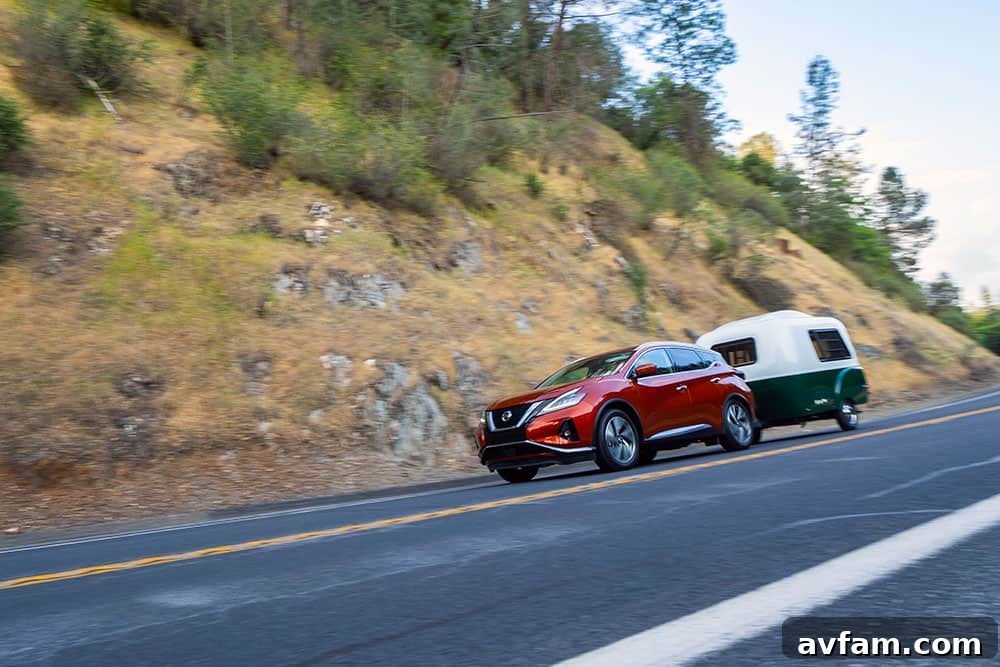
- Nissan Murano Platinum with a Happier Camper HC1
My particular curiosity was drawn to the performance of the Nissan Murano Platinum. With a towing capacity of 1,500 lbs, it was paired with the incredibly stylish and compact Happier Camper HC1, which measures 10 feet in length and weighs a mere 1,100 lbs. This combination perfectly illustrated how smaller SUVs can confidently manage lightweight travel trailers. The Murano performed exceptionally well, its robust 260 horsepower 3.5-liter V6 engine proving more than ample for navigating the rolling hills of Mariposa and ascending towards the breathtaking Yosemite Valley. Its smooth power delivery and stable handling debunked the myth that only large, body-on-frame vehicles are suitable for towing, even on moderate inclines.
The Happier Camper HC1 itself is a testament to innovative design in the travel trailer market. It exemplifies how modern, stylish, and incredibly functional trailers can sleep up to five people, offering genuine comfort and utility, all while remaining easily towable by a relatively compact SUV like the Murano. This pairing truly opened eyes to the possibilities of adventure for a broader range of vehicle owners.
Beyond the Murano, all other Nissan vehicles in the demonstration showcased comparable excellence in their respective towing categories. The Titan, with its formidable power, and the NV Passenger van, designed for robust utility, particularly stood out for their superior suspension setups, which are optimally engineered for extended towing across diverse and challenging terrains. Nissan’s dedication to providing a seamless towing experience was evident across its entire range, making adventure accessible whether you’re pulling a lightweight camper or a substantial luxury Airstream.
Considering Alternatives: The Appeal of Rooftop Tents
For those who prefer not to tow a travel trailer, or perhaps seek a more minimalist camping experience, virtually all of these Nissan vehicles can be equipped with a high-quality rooftop tent. During the event, a smaller Nissan Rogue was outfitted with a Tepui rooftop tent, which demonstrated remarkable stability and ease of use. A rooftop tent offers several distinct advantages: it frees up valuable interior space in your vehicle for additional gear and supplies, significantly reduces the complexity associated with towing, and inherently injects an exhilarating element of adventure into any journey. It’s a fantastic option for spontaneous road trips and exploring remote areas without the commitment of a trailer.
Essential Factors for Safe and Successful Travel Trailer Towing
Embarking on a towing adventure requires careful consideration of several critical factors to ensure both safety and optimal performance. Understanding these elements will empower you to choose the right travel trailer for your vehicle and enjoy countless worry-free journeys.
1. Towing Capacity: Your Vehicle’s Maximum Load
The absolute first step is to definitively determine your vehicle’s exact towing capacity. This crucial figure specifies the maximum weight your vehicle can safely pull. Towing capacity is not universal even within the same model; it can vary significantly based on the vehicle’s year, specific engine size, transmission type, and even axle ratio. Always consult your vehicle’s owner’s manual or the manufacturer’s official website for the most accurate information. It’s wise to give yourself a safety buffer, meaning don’t plan to tow at your vehicle’s absolute maximum capacity, especially if you anticipate challenging conditions.
2. Travel Use and Terrain: Beyond Flat Roads
Where will your adventures take you? Will you be primarily cruising across flat plains, or do your plans involve navigating steep mountain passes and winding, hilly terrains? The type of terrain profoundly impacts towing performance. When towing uphill for extended periods, your engine and transmission will be under considerable strain, affecting fuel economy and requiring careful management. Conversely, driving downhill with a heavy load compromises your vehicle’s braking effectiveness and overall maneuverability. For mountainous regions, it’s highly recommended to factor in an additional cushion for your towing capacity, allowing your vehicle to handle the extra demands without overheating or excessive wear.
3. Tongue Weight: The Key to Stability
Tongue weight refers to the downward force exerted by the trailer’s tongue onto the hitch ball of the tow vehicle. This is an extremely critical, yet often overlooked, factor for safe towing. Generally, the optimal tongue weight should be roughly 9-15 percent of the gross trailer weight. If the tongue weight is too low, the trailer can become unstable and prone to dangerous swaying at speed. If it’s too high, it can overload the rear axle of your tow vehicle, negatively affecting steering, braking, and tire wear. Always ensure your vehicle’s tongue weight limits, as specified in your manual, are not exceeded, and distribute your trailer’s cargo to achieve the correct balance.
4. Gross Combined Weight Rating (GCWR) and Payload
Beyond the simple trailer weight, you must consider the Gross Combined Weight Rating (GCWR), which is the maximum permissible weight of the fully loaded tow vehicle and the fully loaded trailer combined. This includes the weight of all passengers, cargo, and accessories inside your SUV, plus the weight of the trailer and its contents. Every item added to either the tow vehicle or the trailer contributes to this total. Overloading can lead to significant safety hazards, including reduced braking efficiency, increased stopping distances, diminished steering control, and accelerated wear on critical components. Always distribute any added weight in the trailer above or just slightly in front of the trailer’s axle for optimal balance.
5. Braking Systems: Enhanced Control and Safety
For trailers exceeding a certain weight (which varies by region and specific vehicle, but generally around 1,500-2,000 lbs), an independent trailer braking system is essential. These systems work in conjunction with your vehicle’s brakes, significantly reducing stopping distances and improving overall control. Many modern SUVs come with pre-wired connections for trailer brake controllers, or even integrated brake controllers. Ensure your trailer has proper brakes and that your tow vehicle is equipped with a compatible brake controller.
6. Hitches and Sway Control: Connecting with Confidence
The hitch connecting your SUV to the trailer is paramount. Ensure you use the correct class of hitch for your trailer’s weight. For heavier trailers, a weight distribution hitch (WDH) is highly recommended. A WDH redistributes weight more evenly between the axles of both the tow vehicle and the trailer, improving stability and handling. Additionally, sway control devices, whether integrated into the WDH or as a separate add-on, are invaluable for minimizing dangerous trailer sway, especially in crosswinds or during sudden maneuvers.
7. Tires and Maintenance: Ready for the Road
Before any towing trip, thoroughly inspect the tires on both your tow vehicle and the trailer. Ensure they are correctly inflated to the manufacturer’s recommended pressures for towing. Underinflated tires can lead to overheating, blowouts, and poor handling. Regular maintenance of your tow vehicle, including fluid checks, brake inspections, and hitch assembly integrity, is crucial for safe and reliable towing performance.
During the Nissan event, experienced towing experts were on hand to demonstrate just how straightforward it is to properly hitch up a travel trailer. Their guidance reinforced the idea that with the right knowledge and equipment, hitching can be a surprisingly simple process for anyone.
Nissan’s Commitment to the Towing Experience
Nissan’s commitment to delivering an exceptional and safe towing experience is evident in the thoughtful design and features integrated into their vehicles. Innovations such as extendable rear-view mirrors found on the Titan, alongside factory-installed receiver hitches and trailer brake outlets on many of their SUVs, vans, and trucks, underscore their dedication to trailering capabilities. These features are not merely conveniences; they are vital components that enhance safety, visibility, and control for drivers. Don’t let your current vehicle deter you from embracing the freedom and excitement of a vacation on wheels this summer. With the right Nissan and the proper preparation, your next adventure is well within reach.
Ready to explore the great outdoors with confidence? Your adventure awaits!