

From the sidewalk it looks simple: a few movers, a staircase, and a piano. Inside a classic Chicago three-flat the reality is much more complex. Upright pianos commonly weigh 300–500 pounds, baby grands 500–800, and full concert grands well over 1,000 pounds. Put that weight on a narrow, turning stairway with a tight landing and a doorframe that was never designed for an instrument of that size, and piano moving becomes a planning-intensive exercise in judgment, coordination, and technique.
The Job Starts on Paper, Not on the Stairs
Experienced movers begin with measurements, not muscle. Every potential route is checked: doorways, hallways, landings, stair runs, and any tight turns are measured and compared to the piano’s widest, tallest, and longest dimensions. In older Chicago buildings, staircases often feature ninety-degree turns or switchbacks with compact landings. Those landings frequently determine whether a move will succeed or require an alternate plan.
If the numbers don’t add up, the plan changes before anyone straps on gloves. Alternatives include changing the approach angle, temporarily removing a handrail or trim, or choosing a different staircase. For uprights the key question is whether the instrument can be tilted safely without stressing its frame. For grands, professionals often opt to travel on the instrument’s side on a padded skid board when stair geometry is tight.
Protecting the Instrument Before It Leaves the Floor
Once the route is finalized, wrapping and protection become the priority. The piano is thoroughly padded with moving blankets and secured so nothing shifts during the lift. Lids and key covers are closed and strapped; corners and edges receive extra padding to protect both the piano and the building’s finishes. These precautions prevent cosmetic and structural damage that can be costly and irreversible.
Grand pianos require additional preparation:
- Legs and pedal lyres are removed and wrapped separately for transport.
- The body is placed on its side on a padded skid board or spider board for stair travel.
- Heavy straps bind the piano to the skid so it behaves as one controllable unit.
Tipping a grand on its side can look alarming to a first-time observer, but the instrument’s design tolerates this orientation for short moves. On restrictive staircases this positioning often makes the difference between a smooth move and an impossible one.
Equipment and Roles on a Chicago Staircase
Strength alone is not enough to move a piano safely. The right tools and clear role assignments matter equally:
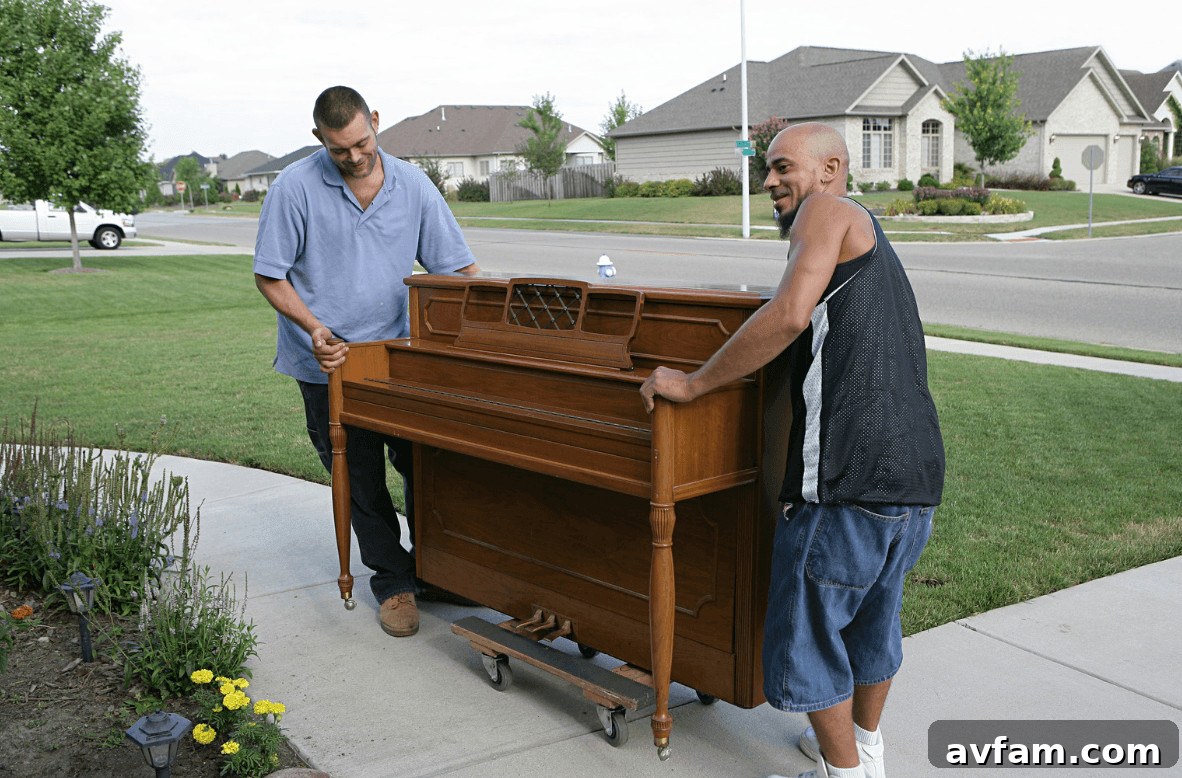
- Four-wheel piano dollies for flat hallways and lobbies
- Heavy-duty straps and harnesses to control the load on stairs
- Padded skid boards to support grands and heavy uprights
- Stair rollers or glides for particularly steep or narrow runs
On a narrow stairway weight is deliberately distributed so the movers below carry the majority of the load while those above guide and stabilize. The mover at the bottom performs the hardest physical work; the mover at the top provides critical oversight, calling each step, monitoring clearances, and coordinating timing so the team operates as a single unit rather than four independent lifters.
Communication: The Invisible Safety System
Piano moves fail more often because of poor communication than because of a lack of strength. A piano cannot be rushed up a flight of stairs. Every step is taken on a verbal count, and the instrument is often allowed to rest on the straps between movements, especially on long or steep runs. The turn at the landing is usually rehearsed before the piano enters the stairwell.
Local experience matters. Crews familiar with pre-war neighborhoods such as Logan Square and Lincoln Park know that older staircases are often steeper, narrower, and less consistent than modern code would allow. Handrails may be weak, treads uneven, and plaster walls vulnerable to chips. Hiring local piano movers in Chicago who understand these conditions removes much of the guesswork on moving day.
Weather, Timing, and the Instrument’s Health
Weather and timing are part of the planning. A piano is a delicate combination of wood, felt, and metal; temperature and humidity affect each of those materials. A wet or icy stoop is dangerous for the crew and the instrument, and a cold piano should not be brought straight into a hot, dry room where sudden environmental change can cause stress.
Professional movers take precautions such as:
- Clearing or treating exterior steps and entries for ice and moisture
- Laying down runners to protect floors and improve traction
- Avoiding sudden temperature shocks and allowing gradual acclimation when possible
These details rarely appear in a brief estimate but become evident in the instrument’s condition in the weeks after the move.
After the Climb: Reassembly and Settling In
Moving the piano upstairs is not the final step. A grand’s legs and pedal lyre are reattached, the instrument is brought upright off the skid, and it is positioned carefully in the room. Placement relative to radiators, supply vents, and exterior walls is important; extreme temperature swings shorten the life of a soundboard and destabilize tuning.
Most technicians recommend waiting a couple of weeks before scheduling a tuning so the piano can settle into its new environment. The move itself combined with new temperature and humidity conditions will alter string tension and soundboard shape slightly.
Ultimately, moving a piano up a Chicago staircase is not about brute force. It’s about precise measurement, careful preparation, proper equipment, experienced technique, and disciplined communication. When all those elements come together, the most memorable part of the job is the quiet moment when nothing goes wrong.