
In the evolving landscape of modern living, where urban spaces are becoming increasingly compact, the challenge of efficient storage is paramount. Many small space dwellers, from bustling city apartment residents to cozy tiny home enthusiasts, grapple with the perennial problem of clutter and the struggle to make every square inch count. Traditional storage solutions often fall short, failing to harness the full potential of a living area, especially when it comes to vertical space. This is where innovative design steps in, transforming limitations into opportunities for ingenious solutions that not only store but also enhance the functionality and aesthetic of a home.
Enter the Stepcase, a remarkable creation by Danny Kuo of Danny Kuo Design. This groundbreaking piece of furniture addresses the critical need for optimized storage, particularly for individuals blessed with ample vertical wall space but constrained by limited floor area. The Stepcase isn’t just another shelving unit; it’s a testament to multifunctional design, ingeniously combining accessible storage with an integrated means of reaching its upper echelons. Its very existence redefines what a bookcase can be, turning a static storage item into a dynamic, interactive element of home organization.
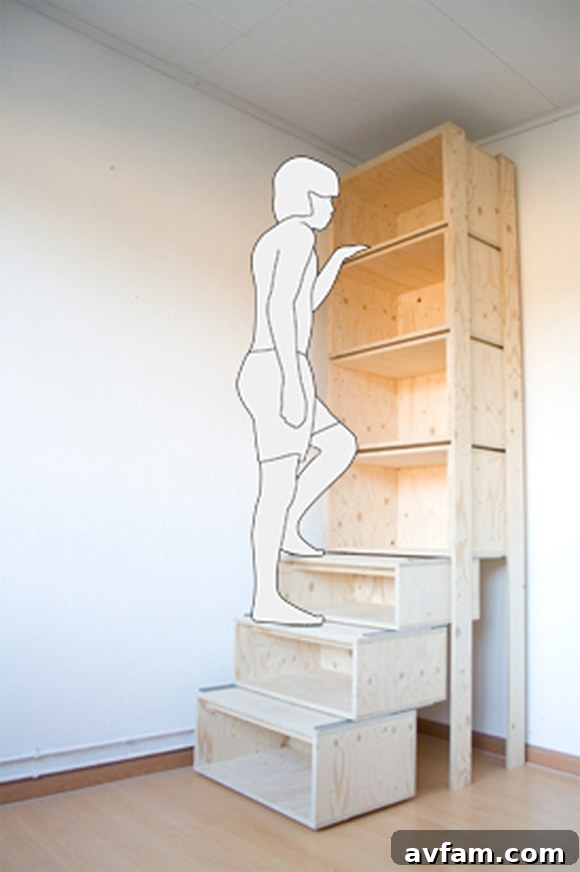
The Ingenious Mechanics of the Stepcase: Storage Meets Accessibility
At the heart of the Stepcase’s brilliance lies its deceptively simple yet profoundly effective mechanism. Envision a sleek, contemporary bookcase that seamlessly integrates into your living space, offering ample room for books, decor, and personal belongings. Now, imagine needing to access items stored on its highest shelves, often a precarious task requiring a step stool or a ladder that itself consumes precious space. The Stepcase eliminates this dilemma with an elegant solution: its bottom three fully functional shelving units are designed to ingeniously pull out, transforming into a sturdy, accessible set of stairs.
This retractable stair feature is a marvel of engineering and thoughtful design. When not in use, these units appear as conventional shelves, blending perfectly with the overall structure and maximizing storage capacity. However, with a simple pull, they slide forward and lock into place, forming robust steps that allow safe and effortless access to the higher compartments. This dual-purpose functionality is what truly sets the Stepcase apart. It’s not merely a storage unit; it’s an access system hidden in plain sight, ensuring that every inch of vertical space, no matter how high, remains fully usable and organized. This smart integration epitomizes the concept of space efficiency, providing both storage and the means to reach it without requiring additional furniture or sacrificing valuable floor area.
Addressing the Urban Living Conundrum: Maximizing Every Square Inch
For those navigating the complexities of small space living – be it a studio apartment, a compact urban loft, or a minimalist dwelling – every design choice carries significant weight. The common predicament is the need for storage versus the desire for an uncluttered, open feel. Traditional furniture often forces a compromise, leading to either an abundance of storage that overwhelms the space or a sparse environment lacking essential organizational capacity. The Stepcase directly confronts this challenge by providing a robust storage solution that intelligently leverages verticality, thereby freeing up valuable floor space.
Consider the typical struggles: limited floor area for bulky cabinets, insufficient closet space, and the difficulty of utilizing high ceilings effectively. The Stepcase offers a transformative approach. By utilizing the often-underutilized vertical plane, it allows residents to store a substantial volume of items without encroaching on the room’s footprint. This is particularly beneficial in rooms with high ceilings, where the upper portions of walls frequently remain barren due to accessibility issues. With the Stepcase, those previously out-of-reach zones become prime real estate for books, seasonal items, collectibles, or anything that benefits from being stored away yet occasionally accessed. It’s a paradigm shift in how we perceive and utilize the dimensions of our living environments, offering a sophisticated blend of practicality and spatial intelligence.
Beyond Functionality: The Aesthetics and Philosophy of Smart Design
While the Stepcase’s functionality is undeniably its most striking feature, its aesthetic appeal and the underlying design philosophy are equally commendable. Even in its prototype form, as captured in the accompanying image, the design exudes a sense of clarity and purpose. It embodies the principle that good design is often simple, well-considered, and elegant in its execution. The clean lines and straightforward construction hint at a minimalist approach, ensuring that the unit can seamlessly integrate into a variety of interior styles, from contemporary and industrial to more classic aesthetics.
Danny Kuo’s creation resonates with the broader movement towards smart, adaptable furniture that prioritizes user experience and spatial efficiency. It’s not just about creating a piece that looks good; it’s about crafting a solution that solves a real-world problem with ingenuity and grace. The Stepcase stands as a prime example of “well-pondered design,” where every element serves a specific purpose, contributing to the overall functionality and visual harmony. This kind of thoughtful design makes us “marvel at the simplicity of good” ideas and inspires a desire for housewares that are not just functional but also captivating conversation pieces.
From Concept to Creation: The Journey of the Stepcase
The journey of any innovative product often begins with a compelling prototype, a tangible manifestation of a groundbreaking idea. The image provided offers a glimpse into the Stepcase’s initial iteration, showcasing its core concept in a functional yet perhaps less refined state. Even in this early form, the potential is clear. The primary challenge in such a build, as astutely observed, lies in ensuring the bottom sections can robustly support the weight of a person climbing them. This critical aspect underscores the engineering precision required to translate a brilliant concept into a safe and reliable product.
Fortunately, the Stepcase has transcended its prototype phase. It has since been meticulously refined and proudly showcased at a multitude of prestigious design exhibitions, garnering attention and acclaim from industry experts and design enthusiasts alike. The evolution from a raw prototype to a finished product likely involved rigorous testing, material selection, and aesthetic enhancements, all aimed at perfecting its functionality, durability, and visual appeal. This transition from a proof-of-concept to a market-ready item highlights the dedication of Danny Kuo Design to bringing truly revolutionary storage solutions to homes around the globe.
Who Can Benefit Most from This Revolutionary Storage Solution?
The Stepcase is a versatile piece of furniture designed to appeal to a broad demographic facing the universal challenge of limited space. It is particularly well-suited for:
- **Urban Apartment Dwellers:** Residents in small city apartments or studios who need to maximize every vertical inch for storage without cluttering valuable floor space.
- **Students and Young Professionals:** Those living in compact dorms or starter apartments seeking efficient and stylish organizational solutions.
- **Loft Owners:** Individuals with high ceilings who struggle to access the upper portions of their walls or high shelves without a cumbersome ladder.
- **Minimalist Enthusiasts:** People who appreciate clean lines and multifunctional furniture that reduces the need for multiple, single-purpose items.
- **Home Library Aficionados:** Book lovers who need extensive shelving and easy access to their entire collection, even those books stored at significant heights.
In essence, anyone seeking an elegant, practical, and space-saving solution for vertical storage will find the Stepcase an invaluable addition to their home.
The Future of Furniture: Inspiring Adaptable Living
The Stepcase by Danny Kuo is more than just a piece of furniture; it’s a statement about the future of living in increasingly compact environments. It champions the idea that furniture should be adaptable, intuitive, and seamlessly integrated into our daily lives, rather than merely occupying space. This type of innovative thinking inspires further exploration into multifunctional design, encouraging designers and homeowners alike to rethink conventional layouts and embrace creative solutions.
The call to action from the original article, inviting those who attempt similar DIY builds to link them up, speaks to the broader impact of such designs. It fosters a community of innovation, where brilliant ideas like the Stepcase not only solve immediate problems but also spark creativity and encourage others to push the boundaries of home organization and design. Danny Kuo’s stroke of brilliance offers a glimpse into a future where our living spaces are smarter, more efficient, and exquisitely tailored to our evolving needs.
Kudos to Danny for a stroke of brilliance in creating the Stepcase. For more insights into this innovative design and other projects, visit Danny Kuo Design. We eagerly anticipate how such inventive solutions will continue to shape our homes and daily lives.