
Worm Drive vs. Sidewinder Circular Saws: The Ultimate Guide for DIYers and Pros
For anyone engaged in home improvement, construction, or even basic woodworking projects, the circular saw stands out as an indispensable tool. It’s a true workhorse, capable of making fast, accurate straight cuts through a wide array of materials. However, what many casual users might not fully grasp is that “circular saw” isn’t a single, uniform category. Instead, the market is primarily dominated by two distinct types: the sidewinder and the worm drive. Understanding the fundamental differences between these two can profoundly influence your project efficiency, cut quality, and overall experience. As a blogger deeply immersed in the world of home improvement, I’ve often found myself pondering these nuances. To thoroughly explore the sidewinder vs. worm drive debate, I consulted with my good friend, Robert Robillard, a seasoned carpenter and a reputable authority on tools and construction challenges, who shares his expertise at A Concord Carpenter. His practical, real-world insights proved invaluable in demystifying these powerful machines.
My own journey as a DIYer, having lived predominantly on the West Coast, meant my exposure was largely limited to what I simply knew as “circular saws,” which almost exclusively turned out to be sidewinder models. The concept of a “worm drive saw” was, for a time, a more enigmatic term. It became clear that geographical location and historical marketing have played a fascinating and significant role in shaping preferences and common usage patterns across the construction industry and among home users.
The Regional Divide: East Coast vs. West Coast Saw Preferences
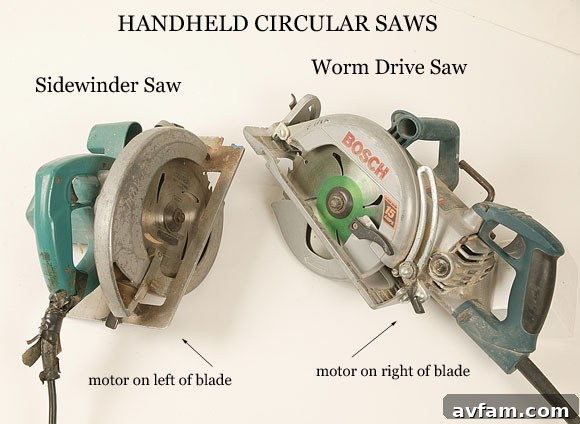
It’s more than just an anecdote; there is a discernible regional bias in the type of circular saw that contractors and DIYers tend to favor across the United States. This intriguing trend can be traced back to the early days of power tool marketing and the specific demands of regional construction practices. Sidewinder saws, with their inherently lighter build and often more accessible price point, established an early foothold on the East Coast. They appealed to a broad range of trades and general home users due to their convenience and versatility for everyday tasks. Conversely, the more robust, high-torque worm drive saws gained legendary status on the West Coast, particularly among framing crews and professionals involved in heavy-duty construction. The iconic SKIL 77 worm drive saw, for instance, evolved into a veritable legend – a powerful workhorse synonymous with demanding, large-scale projects. Many right-handed users gravitate towards worm drive saws because the blade is positioned on the left side of the motor. This unique placement offers an unobstructed, clear view of the cutting line, which is a critical advantage when precision and accuracy are paramount for critical cuts. For general DIYers and those seeking a more budget-friendly and user-friendly option, the sidewinder’s advantages of lighter weight and more approachable cost have cemented its place as a popular choice, making it the go-to for countless weekend warriors and home renovators nationwide, blurring the traditional regional lines over time.
Worm Drive Saws: Unmatched Power, Precision, and Durability
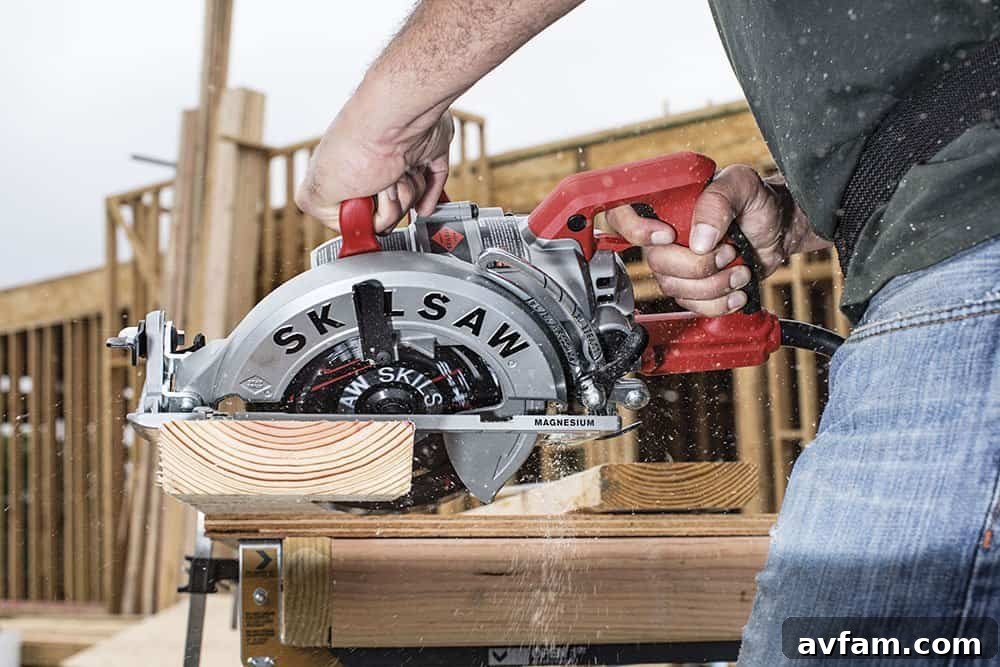
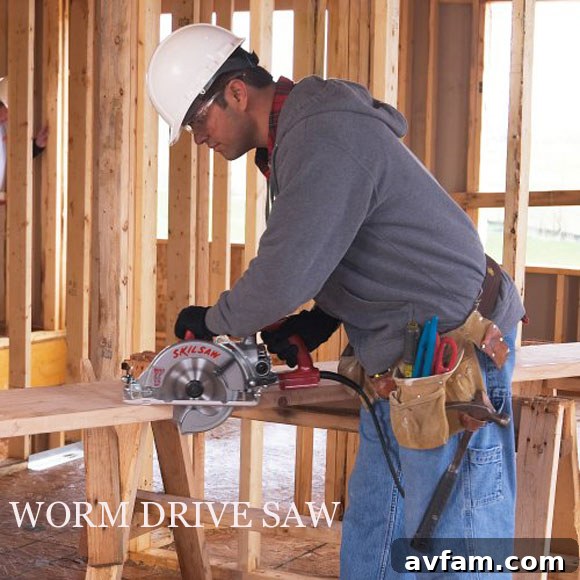
Robert Robillard was quick to provide a comprehensive breakdown of the intrinsic differences distinguishing these two types of saws. Carpenters across generations, from the bustling East Coast to the expansive West Coast, have consistently relied on worm drive saws for their formidable capabilities in critical structural work such as framing, intricate stair construction, and robust roof rafter installation. The key to the worm drive’s superior performance and enduring power lies within its ingenious internal gearing mechanism. The motor is positioned in line with the blade, directly driving a “worm gear.” This worm gear then transfers power to a helical gear, which is responsible for spinning the blade. This unique and specialized gear configuration allows for a significant multiplication of torque, even at relatively lower RPMs, bestowing the worm drive saw with immense cutting power and the ability to maintain consistent force. When a direct drive (sidewinder) saw might bog down, struggle, or even stall under heavy loads or through stubborn materials, a worm drive will often power through with remarkable resilience, maintaining its cutting speed and efficiency. This translates directly into a more powerful, consistent, and cleaner cut, especially when tackling thick, dense, knotty, or even wet lumber – materials that would pose a significant challenge to less robust saws.
Historically, this added power and robust construction came with a notable trade-off: weight. For many years, worm drive saws were considerably heavier than their sidewinder counterparts, making them less appealing for carpenters who weren’t exclusively engaged in framing or other heavy-duty structural work. However, as Robert notes, “In my opinion, worm drive saws are unmatched for their line of sight and blade visibility [blade on left for right handers] as well as their ample power.” The ability to clearly see the blade’s precise path, particularly for right-handed users who get an unobstructed view looking down the blade, is a significant advantage for achieving exceptional accuracy and ensuring safety during critical cuts. As the construction industry continues to evolve, embracing new materials and advanced building techniques, so too do the tools of the trade. Modern technological advancements have led to the development of lighter, more ergonomically designed worm drive models, such as the DEWALT 13.8 saw. These innovations skillfully bridge the gap between raw, unadulterated power and enhanced user comfort, offering impressive torque without the excessive heft of older models. This continuous innovation has made worm drive saws more versatile and appealing to a wider spectrum of professionals and serious DIYers who demand both power and maneuverability.
Sidewinder Saws: Lightweight Agility and User-Friendliness
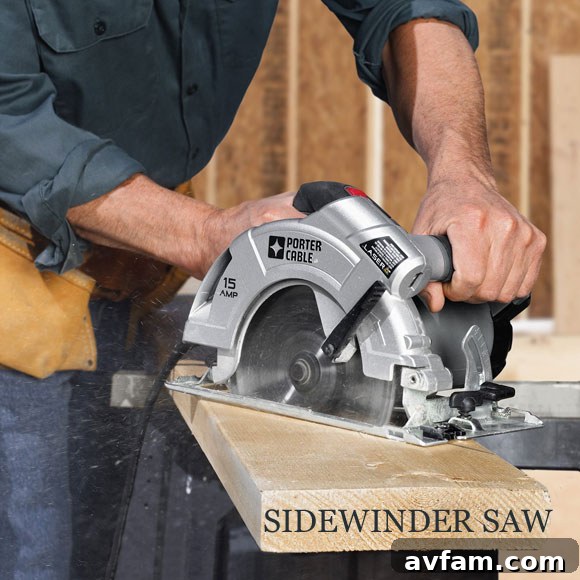
In stark contrast to the heavy-duty, torque-centric worm drive, sidewinder saws, also widely known as direct drive saws, are conceptualized and designed with a distinct philosophy in mind: portability, ease of use, and quick cutting speed. Their motor is mounted perpendicularly to the blade, directly driving it with minimal gearing. This simpler and more direct mechanism results in a lighter, more compact, and often more agile tool. Sidewinders are frequently the preferred choice for tasks that necessitate frequent movement, overhead cutting, or repetitive, less strenuous cutting operations. “Sidewinders or direct drive saws are small, light and get the job done,” Robert explains concisely. For a significant number of DIYers and even a segment of professional contractors, the reduced weight makes them considerably less fatiguing to use over extended periods, making them an ideal choice for tasks like precisely cutting plywood sheets, installing decking, or general cross-cutting of dimensional lumber. Their typically faster blade speed can also be a distinct advantage for achieving quick, clean cuts on thinner materials where sheer power is less critical than cutting velocity. Furthermore, the cost-effectiveness of sidewinders plays a substantial role in their widespread adoption, making them an incredibly accessible entry point for anyone looking to equip their home workshop or jumpstart their construction projects.
While sidewinders excel in agility, convenience, and speed, they do come with certain limitations. The direct drive system inherently produces less torque compared to a worm drive. This means they can be more prone to stalling, slowing down, or bogging down when confronted with very thick, extremely hard, or particularly wet materials, or when attempting exceptionally long rip cuts that demand sustained power. Additionally, for right-handed users, the blade is typically positioned on the right side of the motor. This placement can sometimes obstruct the line of sight for specific cuts, particularly when cutting off the left side of a board or when making certain bevel cuts, which might feel less intuitive for some users. Despite these considerations, for everyday tasks, intricate finish carpentry, and a myriad of general home improvement projects, the sidewinder remains an incredibly effective, practical, and user-friendly tool. Robert’s own usage pattern perfectly illustrates this practical reality: “I personally own both and if I’m making a few cuts I use the lighter sidewinder. If I’m on a framing job – it’s the worm drive.” This pragmatic approach highlights the versatility and complementary nature of owning both types of saws to meet the diverse demands of a professional job site.
Choosing Your Champion: A Comprehensive Side-by-Side Comparison
Deciding between a worm drive and a sidewinder circular saw ultimately boils down to a clear understanding of your specific project needs and the types of materials and tasks you’ll be regularly tackling. Here’s a more detailed, feature-by-feature comparison to help you make the most informed decision:
Weight and Ergonomics
- Worm Drive: Traditionally heavier due to the robust motor, complex gearing, and durable construction, which provides a more stable and planted feel during heavy, deep cuts. The inline motor also contributes to a longer tool body, which can be advantageous for reaching. Modern designs are actively working to reduce this weight difference, but they generally remain the more substantial tool.
- Sidewinder: Significantly lighter and inherently more compact. The motor is typically positioned across the blade, resulting in a shorter, wider footprint. This design makes them considerably easier for overhead work, frequent transport, and significantly reduces user fatigue during prolonged or repetitive use.
Power and Torque
- Worm Drive: Absolutely excels in torque. The unique worm gear mechanism effectively multiplies rotational force, enabling it to power through exceptionally tough materials, wet wood, or dense composites without easily bogging down. This makes it the superior choice for ripping long, thick boards or cutting large, heavy timbers.
- Sidewinder: Generally offers higher RPMs (revolutions per minute) but inherently less torque. They are excellent for quick, clean cuts on thinner or softer materials where cutting speed is more critical than raw brute power. However, they can struggle and potentially stall on very demanding or resistant cuts.
Blade Visibility and Handedness
- Worm Drive: The blade is consistently positioned on the left side of the motor (when viewed from the back). For the vast majority of right-handed users, this configuration provides an excellent, unobstructed view of the cut line, greatly enhancing precision, control, and safety, especially for critical cuts like rafters or intricate stair strings.
- Sidewinder: The blade is typically on the right side of the motor for right-handed users. This can sometimes mean looking over the motor to clearly see the cut line, which might feel less natural or slightly obscure the view for some. Interestingly, many left-handed users often find sidewinders more intuitive and ergonomic for their cutting visibility.
Applications and Best Use Cases
- Worm Drive: Considered the professional’s gold standard for heavy-duty construction. It is perfect for framing entire houses, cutting engineered lumber (like LVLs), making precise cuts on thick concrete forms (with specialized blades), ripping large sheets of structural plywood, and virtually any task requiring sustained power, maximum depth of cut, and uncompromising precision.
- Sidewinder: The ultimate versatile tool for the general contractor and DIYer. Ideal for light framing, accurately cutting thinner plywood and sheet goods, detailed trim work, decking installation, fencing projects, and general home repair tasks where portability, ease of handling, and quick setup are paramount.
Cost and Maintenance
- Worm Drive: Generally commands a higher price point due to their more complex gearing, robust motor, and heavy-duty construction. They are purpose-built for extreme durability and often boast a longer operational lifespan under consistently heavy use.
- Sidewinder: Typically more affordable, making them an excellent value proposition for most homeowners, weekend warriors, and occasional users. Maintenance is generally straightforward and less complex due to fewer intricate moving parts.
The Professional’s Perspective: Why Many Carpenters Own Both Saws
Robert’s insights truly underscore the pragmatic and highly optimized approach adopted by seasoned professionals. His statement that “Many carpenters who do rafter and stair work would have a worm drive and a sidewinder for the opposing bevels” is particularly revealing and highlights a sophisticated understanding of tool application. This isn’t merely about having a backup saw; it’s strategically about optimizing workflow, achieving specific results with greater ease, and enhancing overall project efficiency. The unique motor housing and physical body design of each saw type can sometimes create interference or limitations when attempting to make extreme bevel cuts in certain directions or through particular materials. By having both a worm drive and a sidewinder at their disposal, a carpenter gains unparalleled flexibility to tackle virtually any angle, material thickness, or job site constraint without compromising on the necessary power, critical line of sight, or cutting accuracy. For instance, a worm drive might be the undisputed preference for deep, critical bevels on heavy rafters due to its immense torque and consistent power delivery, while a sidewinder might be expertly employed for smaller, more intricate bevels on delicate trim where its lighter weight, faster blade speed, and quick setup are a distinct advantage. This dual-tool strategy empowers professionals to achieve superior results across a wider range of tasks.
Ultimately, the choice between a worm drive and a sidewinder circular saw isn’t about one being inherently “better” or universally superior than the other. Instead, it’s about diligently selecting the absolute right tool for the specific job at hand, one that perfectly aligns with the material, the required cut, and the user’s capabilities. For the professional framer or heavy construction worker, the enduring power, superior line of sight, and robust durability of a worm drive might be utterly non-negotiable. For the weekend warrior tackling a deck project, installing new flooring, or cutting interior trim, the lightweight, user-friendly nature, and affordability of a sidewinder might represent the perfect fit. And for those who, like Robert, delve into a wide array of diverse projects requiring maximum adaptability, owning both types of saws provides an unmatched level of versatility, efficiency, and preparedness for any challenge that arises.
Making Your Informed Decision: What to Consider
When you’re ready to invest in a circular saw, or perhaps upgrade your current one, take a moment to thoughtfully consider these crucial factors to ensure your choice perfectly matches your needs:
- Primary Use: Will you primarily be framing a house, building heavy outdoor structures, or mainly cutting plywood for shelving and interior finishes?
- Material Type: What kind of materials will you mostly be cutting – dense dimensional lumber, engineered wood products, or thinner sheet goods and panels?
- Frequency of Use: Are you a professional using the saw daily for hours, or a DIYer who engages in occasional home projects?
- Budget: What is your comfortable and realistic price range for a new power tool of this caliber?
- Physical Strength and Endurance: Can you comfortably handle a heavier tool for extended periods, especially for overhead or long rip cuts, without undue fatigue?
By carefully evaluating these points, you can align your circular saw choice with your personal needs, project demands, and physical comfort. Don’t hesitate to visit a local hardware store or tool shop to physically feel the weight, balance, and overall ergonomics of both types of saws in your hands. Test out how the blade visibility feels for you with both configurations. Remember, the best circular saw for you is ultimately the one that empowers you to work safely, efficiently, comfortably, and with utmost confidence on all your projects.
Share Your Experience!
I’m genuinely curious and eager to hear from you, my readers! What type and brand of circular saw do you currently own and use most frequently? What specific factors or experiences led you to choose it, and what have your experiences been like in terms of performance, durability, and ease of use? Your valuable insights and firsthand feedback are incredibly important and invaluable to fellow home improvement enthusiasts and professionals alike who are navigating this choice. Please share your thoughts and experiences in the comments section below!
photo: Fine Homebuilding