
Mastering Workshop Efficiency: Embrace First Order Retrievability for Ultimate Tool Organization
Every maker, craftsman, and DIY enthusiast shares a common frustration: the endless hunt for a specific tool that you know you own. That precious time spent rummaging through cluttered drawers, disorganized toolboxes, or overflowing workbenches could be time spent creating, building, or repairing. While traditional tool chests and rolling carts offer some level of storage, they often fall short in providing the immediate, effortless access that truly streamlines your workflow. What if there was a better way to organize your tools, a system designed to put everything you need literally at your fingertips?
Enter the ingenious concept of “First Order Retrievability,” a philosophy championed by renowned maker and builder Adam Savage. This approach isn’t just about storing tools; it’s about optimizing their accessibility to maximize your productivity and enjoyment in the workshop. Savage’s system aims to eliminate the friction of searching, allowing you to grab any tool you need without moving another item, dramatically cutting down on wasted time and boosting your focus on the task at hand.
The Hidden Costs of Disorganized Tools
Before diving into the solution, let’s acknowledge the problem. Traditional tool organization methods, while seemingly practical, often introduce inefficiencies:
- Tool Chests: Excellent for secure storage and protecting tools, but their drawer-based system necessitates opening multiple compartments and often digging past layers of other tools to find what you need. This multi-step process disrupts flow.
- Rolling Tool Carts with Trays: Useful for bringing a selection of tools to your immediate workspace. However, without dedicated slots or compartments, these trays quickly devolve into a chaotic pile, making individual tools hard to spot and retrieve. They offer temporary portability but often lead to long-term clutter.
- Over-Reliance on Memory: Many rely on their memory to recall where a tool was last placed. This is inherently unreliable and inefficient, especially when working on complex projects or after a break.
The cumulative effect of these inefficiencies is significant. It’s not just a few seconds lost here and there; it’s minutes turning into hours over a project, leading to frustration, project delays, and sometimes even the repurchase of tools you already own but simply can’t find.
Understanding “First Order Retrievability”: Adam Savage’s Golden Rule
At its core, “First Order Retrievability” means that every single tool has a dedicated, immediately accessible spot. You should be able to reach for any tool you need and retrieve it without having to move, shift, or disturb any other tool. This isn’t just about neatness; it’s a strategic approach to workshop layout and tool storage designed around the principle of uninterrupted workflow.
Key Principles of First Order Retrievability:
- Immediate Access: No drawers to open, no lids to lift, no piles to sift through. The tool is simply there, ready to be picked up.
- Dedicated Home: Every tool has a specific, identifiable place it belongs. This eliminates guesswork and ensures tools are returned to the same spot every time.
- Visual Cues: Ideally, you should be able to see where a tool goes, even when it’s absent, making it easier to return and notice if something is missing.
- Ergonomic Placement: Tools used most frequently should be in the easiest-to-reach positions, minimizing unnecessary movement.
- Minimal Obstruction: No tool should block access to another.
Adam Savage’s genius lies in his practical application of this principle. Instead of accepting the limitations of off-the-shelf storage solutions, he customizes his environment to serve his workflow. His ultimate goal is to spend every possible moment actively building, experimenting, or fabricating, rather than engaging in the unproductive task of shuffling through drawers searching for tools.
The Portable Tool Stand: A Practical Manifestation of First Order Retrievability
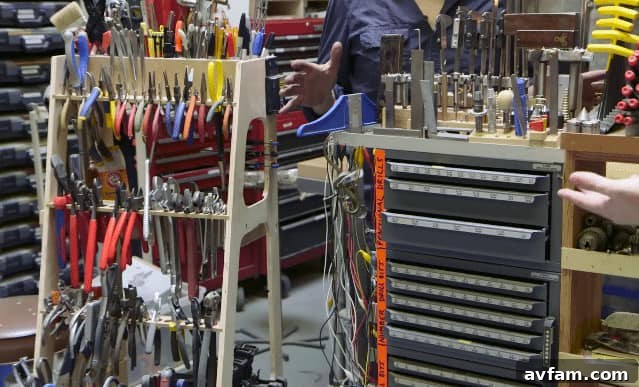
One of the most effective and visible examples of First Order Retrievability in action is Adam Savage’s custom-built portable tool stand. This isn’t just another tool caddy; it’s a meticulously planned and executed piece of workshop furniture designed for peak efficiency.
Adam’s Approach to Building His Tool Stand:
- Starting Fresh: He began by emptying his entire tool chest onto a large work table. This crucial step allowed him to take a complete inventory of his tools and observe them outside of their old, potentially inefficient, storage paradigm.
- Strategic Grouping: Tools were then grouped not just by type (e.g., all pliers together), but by how they would be used together, or by their physical characteristics suitable for specific storage methods. This functional grouping is vital for a logical layout.
- Designing for Verticality: Recognizing that many common hand tools—like pliers, wrenches, screwdrivers, and files—can hang efficiently, he designed his tool stand with vertical storage in mind. This maximizes space and provides immediate visual access. Slots drilled into wood, custom hangers, and magnetic strips are common elements in such a design.
- Emphasis on Planning: Significantly, Savage reportedly spent more time planning the layout and design of his tool stand than he did on its actual construction. This underscores the importance of thoughtful design in achieving true efficiency. The build itself, once planned, became a relatively quick process, taking only a few hours.
The result is a portable tool caddy that brings a curated selection of essential tools directly to his project, organized in a way that allows instant retrieval. No more fumbling, no more opening drawers; just grab and go. This dedicated stand serves as a testament to how custom solutions can far outperform generic ones when it comes to maximizing workshop flow.
Designing Your Own “First Order Retrievable” Tool Stand
Inspired by Savage’s methodology, you too can transform your workshop by building a custom tool stand or re-organizing your existing space with First Order Retrievability in mind. Here’s a structured approach to get you started:
Phase 1: Inventory and Assessment – Know Your Tools
This is where the journey begins. Be honest about what you have and how you use it.
- Empty and Evaluate: Just like Adam Savage, empty your current tool storage. Spread everything out on a large surface. This visual inventory is critical.
- Categorize: Group your tools. Think beyond just “wrenches” and “screwdrivers.” Consider:
- Most Frequently Used: These deserve prime, most accessible spots.
- Task-Specific Kits: Do you always use certain tools together (e.g., soldering iron, solder, desoldering pump, wire cutters)? Keep them grouped.
- Size and Shape: How can each tool best be stored to minimize footprint and maximize visibility?
- Redundancy Check: Do you have multiple tools that perform the same function? Decide which to keep, donate, or store elsewhere.
- Measure: Record the dimensions of your key tools. This will be vital for designing custom slots and holders.
Phase 2: Layout and Ergonomics – Plan for Efficiency
This is the “planning” phase that Savage emphasizes. Grab a pen and paper, or even CAD software, and start sketching.
- Define Your Workspace: Where will this tool stand primarily reside? Will it move between different areas?
- Prioritize Placement: Assign locations for your most-used tools first. These should be within easy reach without stretching or bending.
- Embrace Verticality: For tools like screwdrivers, pliers, wrenches, files, and even smaller clamps, vertical storage is a game-changer. Consider:
- Slotted Boards: Precisely cut slots in wood can hold tools by their handles or shafts.
- Pegboards: A classic for a reason, offering immense flexibility with various hooks and holders.
- Magnetic Strips: Excellent for metal tools like hex keys, small screwdrivers, or drill bits.
- Utilize All Surfaces: Don’t just think about the front. Can the sides or even the top surface hold less frequently used items, or perhaps a small task light?
- Consider Tool Accessibility: Can you grab any tool with just one hand? Is there enough clearance around each item?
- Future-Proofing: Leave a little room for expansion or slight modifications as your tool collection evolves.
Phase 3: Material Selection and Construction – Bring Your Vision to Life
Once your plan is solid, the building phase can be surprisingly quick.
- Material Choice:
- Plywood: Durable, stable, and widely available. Excellent for the main structure.
- MDF (Medium-Density Fiberboard): Smooth, easy to cut, good for precision slots, but less durable in high-impact areas or with moisture.
- Solid Wood Scraps: Perfect for custom blocks, holders, or reinforcing joints.
- PVC Pipe: Can be cut and adapted for holders for larger tools or coiled items.
- Essential Tools: You’ll likely need a saw (circular, jig, or table saw), a drill with various bits, clamps, and measuring tools.
- Construction Tips:
- Measure Twice, Cut Once: Precision here pays off.
- Secure Joints: Use wood glue and screws for strong, lasting construction.
- Smooth Edges: Sand all cut edges to prevent splinters and give a professional finish.
- Optional Finishes: Apply a coat of paint, polyurethane, or oil to protect the wood and make it easier to clean.
Beyond the Stand: Extending First Order Retrievability Throughout Your Workshop
While a custom tool stand is a fantastic starting point, the principles of First Order Retrievability can and should be applied across your entire workshop for maximum efficiency:
- Pegboard Systems: Re-evaluate your pegboard. Are tools strategically placed? Are there shadow outlines to show where each tool belongs?
- Drawer Organizers: Even in tool chests, implement custom drawer inserts, dividers, or foam cutouts to give every tool a specific, snug home. This prevents tools from shifting and piling up.
- Wall-Mounted Solutions: Consider French cleat systems, magnetic bars for small metal items, or custom shelving for larger equipment.
- Clear Storage Bins: For consumables or project-specific items, clear bins allow for quick visual identification without opening.
- Label Everything: If it’s not immediately obvious what’s inside, label it. This applies to drawers, bins, and even sections of your tool stand.
- Routine Maintenance: Regularly take a few minutes at the end of a session to return all tools to their designated spots. This prevents clutter from accumulating.
The Profound Benefits of an Optimized Workshop
Adopting First Order Retrievability isn’t just about tidiness; it’s about fundamentally changing how you interact with your workspace and projects. The benefits are far-reaching:
- Increased Productivity: Less time searching means more time doing. Your workflow becomes smoother and more efficient.
- Reduced Frustration and Stress: The mental burden of a disorganized space is lifted, making your time in the workshop more enjoyable and less stressful.
- Enhanced Safety: A clean, organized workshop reduces trip hazards and ensures sharp tools are stored safely, minimizing accidents.
- Extended Tool Lifespan: Tools that have a dedicated home are less likely to be damaged from being dropped, jumbled together, or lost.
- Greater Creativity: With less mental energy spent on organization, your mind is free to focus on creative problem-solving and innovation.
- Professional Appearance: An organized workshop reflects professionalism and attention to detail, whether it’s for personal enjoyment or client work.
Take Control of Your Tools, Master Your Craft
If you’re tired of the endless search, the cluttered benches, and the nagging feeling that your tools are working against you rather than with you, it’s time to embrace the principles of First Order Retrievability. Inspired by Adam Savage’s practical wisdom, investing a little time in thoughtful planning and custom organization can yield immense returns in productivity, efficiency, and sheer enjoyment. Start with a small, portable tool stand, or begin by decluttering a single section of your workshop. The journey to an optimized, frustration-free making space begins with a single step. Take control of your tools, and watch as you master your craft with newfound efficiency and joy.