

In any serious workshop or garage, the workbench isn’t just a surface; it’s the heart of your operation, a foundational tool that shapes how effectively you tackle every project. Whether you’re undertaking intricate repairs, assembling complex components, fabricating custom parts, or simply organizing your tools, the performance of your workbench directly impacts your precision, efficiency, and overall enjoyment. A well-designed workbench provides the stability, organization, and ergonomic comfort necessary to transform daunting tasks into manageable accomplishments, keeping your essential tools within arm’s reach and fostering a focused, productive environment.
Define Your Project Needs: The First Step to a Perfect Workbench
Before investing in a workbench, it’s crucial to clearly define the primary type of work you’ll be performing. Different tasks demand distinct features and materials from your workspace:
- Heavy Mechanical Work: If your garage is home to automotive repairs, engine overhauls, or metal fabrication, you’ll need a workbench that can withstand significant abuse. Look for a heavy-duty work table with storage featuring a robust, unyielding frame—ideally welded steel. The work surface should be resilient enough to shrug off oil, brake fluid, solvents, and the occasional impact without deforming or degrading. Steel or thick, durable composite tops are excellent choices here.
- Woodworking Projects: For carpentry, cabinetry, or fine woodworking, vibration dampening and clamp-holding capability are paramount. A thicker top, typically made of solid hardwood like maple or oak, is ideal as it absorbs vibrations from sawing and planing, provides a stable surface for chiseling, and offers superior grip for various clamping systems. Integrated dog holes and vises are also highly beneficial.
- Electronics and Precision Work: If your tasks involve delicate electronics, small parts assembly, or intricate measurements, a smooth, static-dissipative surface is key. Excellent lighting, ample power outlets, and a clean, clutter-free environment are critical. Consider anti-static mats and easy-access power strips to protect sensitive components and streamline your workflow.
- General Purpose/Mixed Use: Many garages serve multiple functions. If your projects vary widely, a versatile workbench is your best bet. A sturdy steel frame provides the necessary core strength and durability, while a top surface that can be easily replaced or customized allows you to adapt to different tasks. This approach handles the demanding jobs while giving you the flexibility to refresh your surface when it inevitably gets worn or damaged.
Optimal Sizing and Ergonomic Height for Enhanced Productivity
The physical dimensions of your workbench are critical for both your workflow and the overall functionality of your garage. Begin by accurately measuring your available wall space, but don’t stop there. Crucially, factor in adequate clearance around the bench. You’ll need room to maneuver tool chests, rolling carts, and awkwardly long materials without obstruction. Cramped workspaces lead to inefficient movements, potential safety hazards, and unnecessary frustration, forcing you to work at odd, uncomfortable angles.
Equally important is the workbench’s height, which directly impacts your posture, comfort, and precision. An ergonomically correct height can prevent back strain and fatigue, especially during long work sessions:
- Standing Work (General Purpose): For most tasks performed while standing, the ideal workbench height places the work surface at approximately wrist level when your arms are relaxed at your sides. This allows you to lean in naturally without stooping or reaching excessively.
- Heavy Mechanical Tasks: When applying significant force or leverage, such as breaking loose a stubborn bolt, a slightly lower workbench can be advantageous. This allows you to engage your core and body weight more effectively, reducing strain on your arms and back.
- Precision Work (Wiring, Measuring, Assembly): For detailed tasks requiring fine motor skills and close visual inspection, a slightly higher workbench might be preferred. This brings the work closer to your eyes, minimizing the need to bend over and reducing eye strain.
- Multi-User or Variable Tasks: If your workbench will be shared by multiple individuals of different heights, or if your projects demand varying ergonomic positions, an adjustable-height frame is an invaluable solution. These systems allow for quick customization, ensuring optimal comfort and efficiency for everyone, regardless of the task at hand.

Frame Construction and Work Surface Materials: The Core of Durability
The structural integrity of your workbench hinges on its frame, which must steadfastly hold its shape under immense stress. When clamping a workpiece with a heavy-duty vise, operating a shop press, or applying significant leverage, a flimsy frame will flex, twist, or even collapse, compromising safety and accuracy.
- Frame Strength:
- Welded Steel: This is unequivocally the stiffest and most durable option available. A frame constructed from welded steel provides unparalleled rigidity, making it ideal for the most demanding tasks. It offers maximum stability and longevity, capable of supporting substantial weight and resisting deflection.
- Bolt-Together Steel: While a viable option for many users, bolt-together steel frames require careful assembly. All fasteners must be properly tightened and regularly checked for loosening, as vibrations and heavy use can cause them to work their way free over time. Choose models with substantial steel gauges and robust connection plates for better performance.
- Heavy-Duty Wood: For certain applications, particularly traditional woodworking, a solid wood frame (e.g., from oak or maple) can offer excellent vibration dampening and a classic aesthetic. These frames are often very heavy and stable but may not be as resistant to impacts or fluids as steel.
- Work Surface Materials:
- Hardwood Tops (e.g., Maple, Oak, Birch): Highly prized for their natural beauty and excellent vibration-absorbing properties, hardwood tops are a top choice for woodworking and general utility. They can be sanded down and refinished multiple times, extending their service life significantly. However, they are susceptible to damage from harsh chemicals, extreme heat, and heavy impacts from sharp objects.
- Bamboo: An increasingly popular and sustainable option, bamboo offers excellent moisture resistance and dimensional stability, meaning it’s less prone to warping or shrinking than some other wood types. It’s also quite durable and provides a smooth, appealing work surface.
- Steel Tops: For extreme durability and resistance to fluids, chemicals, and welding spatter, a heavy-gauge steel top is hard to beat. It’s easy to clean and can withstand immense abuse. However, steel can transmit vibrations readily, may scratch softer materials, and generates considerable noise when tools are dropped on it. Rust can also be an issue if not properly maintained.
- Composite or Laminate Tops: Often more economical, composite tops (like MDF or particle board with a high-pressure laminate) offer a smooth, uniform surface that’s easy to clean. They provide decent resistance to light spills but are generally less durable than solid wood or steel and may not withstand heavy impacts or sustained moisture exposure.
- Rubber Matting: While not a primary work surface, a heavy-duty rubber mat can be added to any top to provide cushioning, prevent parts from rolling off, and offer some slip resistance.
Ultimately, a robust steel frame paired with a durable hardwood, bamboo, or composite top often strikes the best balance, handling most garage tasks with minimal fuss while offering adaptability.
Assessing Load Capacity and Enhancing Stability for Safe Operation
When selecting a workbench, manufacturers typically provide load ratings. However, it’s crucial to understand that these figures often refer to “static weight capacity” – the maximum weight a bench can hold when the load is evenly distributed and completely still. Real-world work, however, introduces “dynamic forces” from hammering, pressing, twisting, and vibrating. A workbench that can passively support a heavy engine block might still groan, flex, or even shift dangerously if you’re attempting to break loose a heavily corroded bolt in a vise, exerting sudden, powerful leverage.
True stability is paramount for both safety and the successful execution of tasks. A wobbly workbench is not only inefficient but also a significant hazard. You can substantially boost your workbench’s stability through several key features and installation methods:
- Wide Feet and Leveling Mounts: Benches with a broad footprint distribute weight more effectively and resist tipping. Adjustable leveling feet are essential for compensating for uneven garage floors, ensuring all four corners bear weight evenly and preventing rocking.
- Solid Grip on the Floor: For extremely heavy work, consider rubberized or non-slip feet that prevent the bench from sliding under force.
- Anchoring to the Wall: This is arguably one of the most effective and often overlooked methods for dramatically increasing stability. Anchoring your workbench directly to a structural wall using appropriate fasteners (e.g., lag screws into studs) is a relatively small job that pays enormous dividends. It virtually eliminates wobbles and sway, providing a rock-solid platform for grinding, pressing, hammering, or any task requiring significant force. This added stability allows you to confidently tackle tricky and demanding operations without fear of the bench shifting or moving unexpectedly.
Integrated Storage Solutions for Maximum Efficiency
An efficient workbench is one that keeps your tools organized and accessible. Thoughtful storage solutions can dramatically improve your workflow, reduce wasted time searching for items, and keep your primary work surface clear for actual work. The goal is “point-of-use” storage, where frequently used tools are immediately within reach.
- Drawers: Ideal for smaller items like sockets, wrenches, calipers, measuring tools, and various bits. Full-extension ball-bearing slides are a must for smooth operation and complete access to contents. Consider drawers of varying depths to accommodate different tool sizes.
- Lower Shelves and Cabinets: These are perfect for stashing larger power tools, tool cases, project materials, and bulkier supplies. Adjustable shelves offer flexibility as your tool collection grows or changes. Enclosed cabinets protect contents from dust and debris, presenting a cleaner look.
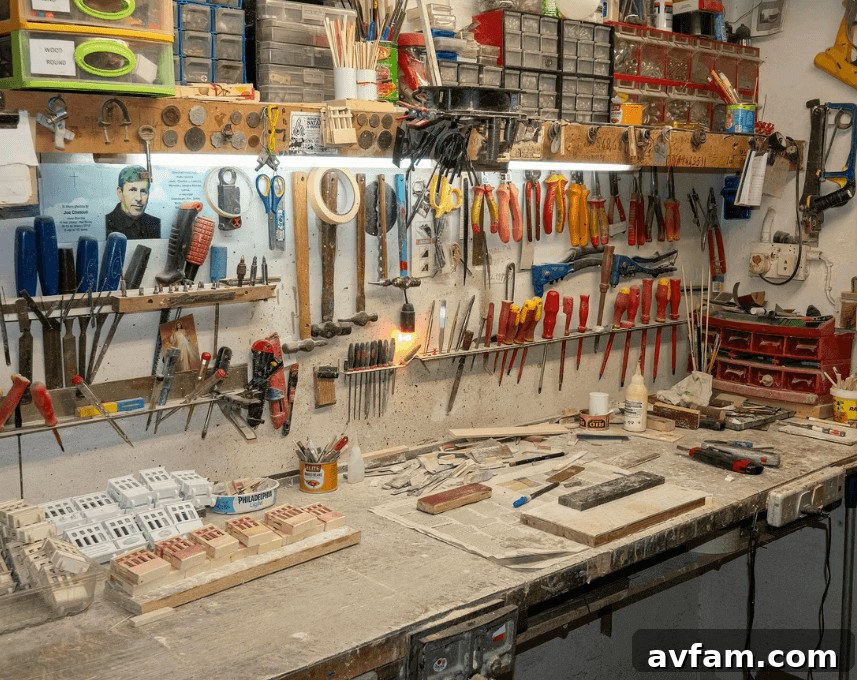
- Pegboards or Back Panels: A classic and highly versatile solution, pegboards or slotted back panels allow you to hang high-use tools directly above your workspace. This keeps them visible, organized, and instantly accessible, minimizing bending or rummaging. Hooks, bins, and specialized holders can be configured to suit any tool.
- Overhead Storage: If space permits, installing shallow overhead cabinets or shelves can provide additional storage for less frequently used items, keeping them out of the way but still within reach with a step stool.
While maximizing storage is beneficial, avoid over-encumbering your workspace. Cabinets or drawers that jut out too far forward can force you to crouch uncomfortably or stretch awkwardly, negating ergonomic benefits. Crucially, ensure ample toe space is kept open at the bottom of the workbench. This allows you to stand directly against the work surface without having to lean over, maintaining a balanced and comfortable working posture.
Optimizing Power Access and Illumination for a Safer Workspace
No modern workbench is complete without convenient access to power and effective lighting. These elements significantly enhance both safety and productivity.
- Integrated Power Solutions: Cluttering your workspace with extension cords creates tripping hazards and constantly forces you to plug and unplug tools, interrupting your flow. The best workbenches incorporate multiple electrical outlets directly into their design. Installing a power strip or a row of outlets along the back edge of the workbench ensures that the main work surface remains clear and free of tangled cables. Consider GFCI (Ground Fault Circuit Interrupter) outlets for added safety, especially in garage environments where moisture might be present. Some advanced benches even feature USB charging ports for modern devices.
- Superior Task Lighting: Good lighting is not just a convenience; it’s a lifesaver that prevents errors, reduces eye strain, and enhances precision. Ambient overhead lighting is a start, but dedicated task lighting is essential. An adjustable LED light mounted directly to the workbench frame, or an articulated lamp, allows you to direct bright, focused illumination precisely where you need it – whether you’re performing intricate measurements, making fine cuts, or wiring delicate components. Look for LEDs with high lumen output and a natural daylight color temperature (around 5000K) for accurate color rendering and reduced fatigue. Being able to clearly see every detail of your work significantly minimizes slip-ups, improves accuracy, and makes extended work sessions far more comfortable.
Fixed or Mobile Installation: Adapting to Your Shop Layout
The decision between a fixed or mobile workbench depends largely on your available space, the nature of your work, and your shop’s overall layout flexibility.
- Fixed Workbenches: For unparalleled stability and the ability to handle the heaviest tasks, fixed benches are the gold standard. They are the ideal choice if your workshop layout is permanent and you frequently engage in operations requiring significant force, such as using a bench vise, pressing components, or heavy hammering. Anchoring a fixed bench directly to a wall or floor virtually eliminates movement, providing a supremely stable platform for precision work and reducing the risk of accidents.
- Mobile Workbenches: If space is at a premium, or if your projects often require you to reconfigure your workspace, a mobile workbench offers invaluable flexibility. The ability to roll your workbench to different areas – closer to a specific tool, a power outlet, or even outdoors – can dramatically improve workflow. However, mobility comes with crucial requirements:
- Locking Casters: These are an absolute non-negotiable feature. Ensure the casters are heavy-duty and equipped with reliable locking mechanisms to prevent the bench from drifting or shifting unexpectedly in the middle of a critical task.
- Caster Quality: Don’t skimp on casters. Cheap casters will bind, break, or fail to lock securely, undermining the purpose of a mobile bench. Look for large, robust, smooth-rolling casters that can handle the workbench’s weight plus your tools and materials.
Many seasoned DIYers and professionals opt for a hybrid approach: a large, incredibly stable fixed main workbench for demanding operations, complemented by a smaller, heavy-duty mobile cart or bench that can be easily wheeled wherever additional workspace or tool access is needed. This combination offers the best of both worlds – uncompromising stability for core tasks and versatile flexibility for everything else.
Common Workbench Types Comparison
| Workbench Type | Best Use | Strengths | Limitations |
| Hardwood top on steel frame | General repair, woodworking, assembly | Good vibration control, durable, serviceable surface (can be sanded) | Sensitive to harsh fluids, welding heat, and heavy impacts. Requires care. |
| All-steel bench | Automotive and heavy metal work, welding, fabrication | Extremely high load capacity, superior fluid and chemical resistance, easy to clean | Transmits vibration, can mark soft materials, noisy, may rust if untreated |
| Adjustable-height bench | Shared workspaces, diverse tasks, ergonomic focus | Ergonomic for multiple users and varied tasks, reduces fatigue | Slightly less rigid than fixed designs (especially under extreme load), generally higher cost |
| Mobile workbench | Small garages, dynamic layouts, supplemental workspace | Flexible positioning, easy cleaning underneath, can be stored away | Reduced stability compared to fixed benches, casters must be high-quality and locked |
| Storage-integrated bench | Tool-dense workflows, small spaces, organization priority | Excellent tool organization, keeps workspace tidy, maximizes vertical space | Can reduce legroom if poorly designed, may limit flexibility for larger tools |
Each workbench design is crafted to serve a specific purpose and excel in particular environments. Matching the workbench’s features to your primary workload and operational style will always yield superior results and a more satisfying experience than simply choosing based on aesthetics or a low price tag.
Investment in Quality: Cost and Service Life
A workbench is not merely a purchase; it’s a long-term investment in your productivity, safety, and the overall functionality of your workspace. The best workbench should serve you reliably for many years, enduring countless projects and significant abuse. The temptation to opt for cheaper, lower-quality options often leads to disappointment and greater expense in the long run.
Flimsy steel legs that flex under moderate load, weak screws that strip out, and particleboard surfaces that swell with moisture or disintegrate with impact are hallmarks of a poorly made workbench. These deficiencies not only compromise the integrity of your projects but also create safety hazards. The cost of continually repairing a busted bench, replacing worn-out components, or ultimately buying a new one far outweighs the initial investment in a solid, well-constructed model. Prioritize quality materials and robust engineering from the outset.
When making your selection, focus on a bench with a strong, heavy-gauge frame, a thick and durable top surface, and high-quality hardware. While additional features like power strips, specialized lighting, or tool organizers can always be added or upgraded later, the fundamental strength and durability of the core structure are non-negotiable. A tough, basic workbench provides the essential foundation, supporting heavier loads, withstanding greater stresses, and requiring minimal maintenance or constant repairs over its extended service life.
Strategic Placement for Maximum Productivity
The location of your workbench within your garage or workshop is just as critical as its construction. Thoughtful placement can significantly streamline your workflow, minimize wasted effort, and enhance your focus on the task at hand. The primary goal is to create an efficient work triangle, much like in a kitchen, where your most frequently accessed tools, power outlets, and other essential workstations are easily accessible.
- Proximity to Resources: Position your workbench close to your main tool storage areas, such as tool chests or cabinets, and convenient power outlets. This minimizes the time and effort spent walking back and forth, fetching tools, or searching for an available power source.
- Ample Working Space: Ensure there’s sufficient clear space around the workbench to accommodate large projects, long pieces of material (such as lumber or pipes), and any auxiliary equipment you might use, like saw horses or rolling carts. Avoid placing it in a high-traffic area where it might impede movement or create bottlenecks.
- Natural and Artificial Light: If possible, position your workbench near a window to take advantage of natural light, which is excellent for detailed work and reduces eye strain. Supplement this with robust artificial lighting, as discussed earlier, to ensure consistent illumination regardless of the time of day or weather conditions.
- Organized Storage within Reach: Beyond the workbench itself, organize your surrounding storage so that your most frequently used tools are literally right at your fingertips. This means not just on the pegboard, but specifically placed so you don’t have to turn your back or take more than a step to grab them. Trust us, fewer bolts will be dropped, and fewer minutes will be wasted hunting for that elusive 10mm socket. This optimized setup ensures you spend your time working, creating, and fixing, rather than navigating an inefficient workspace.
Conclusion
Selecting the ideal workbench for your garage or workshop is a crucial decision that profoundly impacts your efficiency, safety, and enjoyment of your projects. The best workbench isn’t a one-size-fits-all solution; rather, it’s a custom fit that perfectly aligns with your specific workflow, the types of tasks you undertake, and the unique constraints and opportunities of your available space. By carefully considering key factors such as the type of work you’ll do, the optimal size and ergonomic height, the robust strength of its frame, the durability of its work surface, its load capacity and stability, integrated storage solutions, and readily available power and lighting, you can make an informed choice.
Remember, this is an investment in your craft. Choose a workbench that is solid, stable, and strategically set up to ensure tools and storage never slow you down. Install it with care, paying attention to leveling and anchoring, and you will create a high-performing shop space that not only enhances your capabilities but also serves you faithfully and effectively for many productive years to come. A well-chosen workbench is truly the cornerstone of a functional and inspiring workspace.