
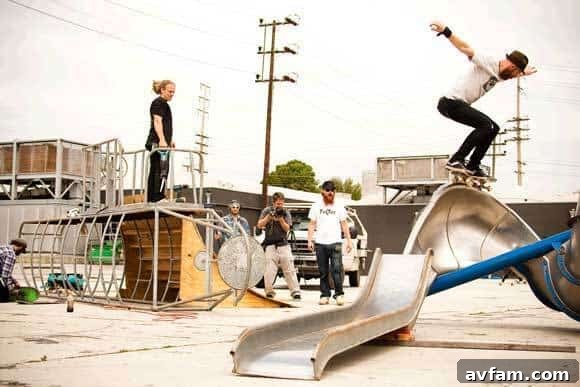
Built To Shred: Where Anarchy Meets Architecture in the World of Action Sports
For enthusiasts of extreme sports and the raw, unadulterated culture of skateboarding, snowboarding, and surfing, the name FUEL TV has long resonated as a beacon. As a devoted fan from its inception, captivated by the energy and creativity of action sports, I’ve always found myself drawn to its programming. I still cherish stacks of old VHS tapes featuring legendary figures like Lance Mountain, Tony Hawk, and the iconic Bones Brigade crew, whose feats continue to inspire. FUEL TV consistently delivers content that speaks directly to this passion, showcasing not just the athleticism but also the innovative spirit at the heart of these disciplines.
The breadth of programming on FUEL TV extends far beyond mere highlight reels. It encompasses everything from pure, adrenaline-fueled skate parts to deep-dive athlete profiles and engaging entertainment shows that capture the unique lifestyle of action sports. Among its most celebrated offerings is the series Built To Shred, a show that perfectly encapsulates the daring and resourceful ethos of this community. Hosted by the extraordinary skater and master builder, Jeff King, Built To Shred is more than just a show; it’s a testament to creativity, problem-solving, and pushing the boundaries of what’s possible.
Jeff King is not just a professional skateboarder; he’s an architectural anarchist, renowned for his ingenious ability to construct awe-inspiring obstacles for skateboarding and other action sports. What sets Jeff apart is his unique approach: he transforms unusual objects and unexpected locations into thrilling playgrounds. His innovative spirit even earned him a feature in the highly popular skateboarding video game, Tony Hawk’s Proving Ground – a game that has, admittedly, consumed more hours of our lives than we care to count. His work on Built To Shred takes this concept to exhilarating new heights.
The Vision Behind Built To Shred: Bigger, Bolder, Beyond Limits
The eagerly anticipated new season of Built To Shred promises an unprecedented spectacle of bigger builds, an expanded array of sports, and a collection of once-in-a-lifetime obstacles. These incredible creations are destined to be conquered by an iconic lineup of adrenaline sports legends. Viewers can look forward to witnessing the groundbreaking feats of skateboarding pioneer Tony Hawk, the dynamic Ryan Sheckler, and X Games Gold Medalist Paul Rodriguez, among many other titans of action sports. Each episode is a journey into the extraordinary, challenging both the builders and the riders to redefine limits.
What truly distinguishes Built To Shred from other do-it-yourself construction shows found on conventional home networks is its guiding philosophy: ‘architecture meets anarchy.’ This isn’t about perfectly plumb lines and conventional blueprints; it’s about embracing chaos, repurposing the unexpected, and crafting functional, yet wildly imaginative, structures that serve as the stage for groundbreaking action. The sheer audacity and inventive spirit behind each project are irresistible, making it a must-watch for anyone who appreciates creative problem-solving and extreme sports.
We recently had the incredible opportunity to sit down with Jeff King himself to delve into his unique world. We explored how he first ventured into the art of ramp building and what exciting, gravity-defying marvels the new season has in store for us. Prepare to get stoked, because this exclusive interview offers a fascinating glimpse into the mind of a true innovator. Read on to discover the passion, the precision, and the pure exhilaration that defines Jeff King’s work.
An Exclusive Interview with Jeff King: Master Builder and Action Sports Visionary
C&H: Hi Jeff – Congratulations on Season 3 of Built to Shred! You’ve truly discovered and mastered an undiscovered niche, and we’ve been absolutely captivated by the creativity displayed in the previous two seasons. That monster ramp you constructed at the “ghetto skate park” in Hawaii, for instance, was absolutely legendary. It’s clear you’ve been involved in both skateboarding and building for a long time, but we’re curious: which passion came first for you, the skating or the building?
Jeff King: Skateboarding, without a doubt. I honestly can’t remember a time when I didn’t have a skateboard close by. It’s been a constant in my life for as long as my memory stretches. However, the building aspect truly began to manifest when I was about 14. That’s when my dad and I collaborated to build what we believe was the world’s first Kingrail. It was a modest but groundbreaking creation, roughly 10 feet long, meticulously crafted from 2x6s, with a 2-inch PVC pipe affixed using nails. Back then, when you’d attempt a boardslide, you’d inevitably leave pieces of your board’s rails stuck under those nail heads – a clear indicator of its DIY roots and the pure, unrefined joy of early ramp building. That experience really solidified my fascination with both riding and creating the ride.
C&H: That’s an amazing origin story for the Kingrail! It perfectly encapsulates the resourceful spirit of early skateboarding. Can you give us some insight into your creative process when you approach building these incredible obstacles? Do you typically have a specific ramp design in mind and then seek out the ideal location for it, or do you start with an interesting location and then draw inspiration from its unique characteristics to design the obstacle?
Jeff King: It really boils down to the specific situation; there’s no one-size-fits-all approach. For example, when we tackled the challenge of building the rock sifter ramp for Kale Sandridge in Hawaii, the chosen location was absolutely paramount. The natural environment and existing landscape dictated the very nature and form of the ramp. It was a direct response to the surroundings. Conversely, when we have a distinct conceptual idea, such as the flat-bar bike or the shopping cart obstacles, those projects are much more of a “shop build.” We construct them in a controlled environment and then transport them to wherever we want to deploy them for a session. Consider the airplane graveyard episode: there were no existing runways or natural landing zones, so we had to engineer and construct every single one from scratch. In such situations, we have to be incredibly strategic and smart about which obstacles we choose to modify or build entirely. So, to sum it up succinctly, my approach heavily depends on whether it’s a conceptual build, driven by a specific design idea, or a location build, where the environment itself provides the primary inspiration and constraints.
The Art of Ramp Building: Evolution and Philosophy
C&H: I must proudly interject that I designed and built my very own 4-foot quarter pipe when I was just 11 years old. All it took was some Masonite, plywood, and 2x4s – simple materials for immense fun. It’s truly astonishing to witness the sheer scale of the mega-ramps at the X Games these days; I can barely fathom their construction and the legions of people involved. What I find particularly compelling about Built to Shred is that most of your projects, while incredibly ambitious, appear attainable for someone with the right knowledge, a few essential tools, appropriate materials, and a good deal of effort. Your work beautifully harks back to the core essence of skating – stripping away the need for a perfect tranny and instead encouraging us to skate on whatever we’ve got available. This raises an interesting question: in your experience, have ramp construction techniques or the materials used significantly evolved over the last 20 years?
Jeff King: It’s hard to precisely recall what skate parks were like two decades ago, and the answer really depends on the type of ramps you’re referring to. I don’t believe that backyard ramps, in particular, have undergone a dramatic transformation. Of course, these days, we tend to incorporate more flat bottom sections for better flow, and if one has the resources, they can invest in superior top surfacing materials for their ramps, such as Skatelite or Ramp Armor – materials engineered for durability and optimal ride. However, many people are still utilizing Masonite, which, to be frank, I’m not a fan of at all. Just for the record, I firmly believe Masonite should never be used for a ramp, whether it’s indoors or outdoors. It simply doesn’t hold up or perform adequately for the demands of skateboarding. Aside from these more advanced surfacing options, the foundational materials remain largely the same: good old plywood and 2x4s form the backbone of most constructions.
As far as the overall construction quality is concerned, I do think that the professionals in the field are consistently improving their craft. In many of the contemporary skate parks, the coping – that critical edge where riders interact with the ramp – is looking exceptionally well-executed. The coping is often a dead giveaway; it’s an area where you can clearly discern whether the builder is also a skater. If the coping protrudes too much or doesn’t extend enough, it instantly tells you who truly understands the rider’s perspective and who doesn’t. A skilled builder who skates instinctively knows the precise angle and protrusion required for optimal grinding and sliding, making a significant difference in the overall rider experience and the longevity of the structure.
C&H: That’s a fascinating insight into the subtle nuances of ramp building and how a builder’s personal experience as a skater translates into superior design. Given your commitment to challenging riders, how do you manage to strike that delicate balance when building a ramp – creating an obstacle that pushes a skater just beyond their current abilities, yet isn’t so easy that it becomes boring, nor so impossible that it’s demoralizing?
Jeff King: It’s genuinely one of the most difficult aspects of what we do. This season, in particular, we encountered a few significant snags with some of our “never-been-done before” ramps. Sometimes, a revolutionary idea that seems brilliant in a rider’s mind or looks fantastic on paper simply doesn’t translate as smoothly to real-life execution. That, however, is one of the most exciting and dynamic aspects of working on Built to Shred – you genuinely never know what’s going to unfold. There’s an inherent element of unpredictability that keeps us all on our toes. I recall when Kale wanted to air out of the rock sifter and land onto a rental truck. Initially, the entire crew thought it was an utterly impossible feat. Despite our doubts, we went ahead and meticulously set it up for him anyway. Lo and behold, after about 15 intense attempts, he wasn’t just landing it; he was spinning front flips off the truck and onto his back! It made us all question if we had perhaps pushed our luck too far, or if Kale was simply superhuman. But it was ultimately his incredible perseverance and unwavering will that transformed what seemed impossible into a breathtaking reality. From my vantage point, I am constantly amazed and surprised by the extraordinary ability and resilience of these riders. It forces me to reconsider what truly constitutes “impossible,” aside, of course, from attempting the “Surf Rail of Death part 2” – some things really are just too wild!
C&H: That story about Kale truly highlights the incredible spirit of action sports athletes! Speaking of building, what essential tools do you consider absolutely indispensable – the ones you never leave home without when embarking on a new ramp construction project?
Jeff King: When it comes to the bare essentials for building a ramp, the circular saw and a powerful drill are, without question, the most critical tools. You simply cannot get anything substantial done without them; everything else, truthfully, is just a luxury or a specialized aid. However, if we’re talking favorites, I do have a deep affection for my portaband – that portable metal-cutting bandsaw is a game-changer for so many custom fabrication tasks. And, of course, chainsaws; they’re practically essential for breaking down raw materials or clearing terrain. But really, who am I kidding? I genuinely love all my tools. Each one has its own unique purpose and special place in my arsenal, contributing to the overall magic of bringing these structures to life.
C&H: It sounds like you have a true appreciation for your craft and the instruments that enable it. Building such dynamic and often temporary structures, safety must be a paramount concern. Do you have any crucial safety tips you can share – specific checks you always perform on a ramp or obstacle once you’ve completed its construction, before anyone even thinks about dropping in?
Jeff King: Safety is absolutely non-negotiable, and it’s a lesson I’ve learned through experience, sometimes the hard way. First and foremost, always keep your eyes peeled for any screws that might be sticking out – even a tiny protrusion can cause a catastrophic snag for a rider. Secondly, ledgers are your friend. Using them correctly provides crucial structural integrity and prevents unexpected collapses. Over the years, I’ve developed an almost strange, obsessive need to ensure maximum safety when I’m working. Perhaps it’s the multiple emergency room visits I’ve had to endure to get slivers pulled out of my eyes, or the hundreds of splinters I’ve collected in my hands – these experiences truly drive home the importance of protective gear. So, yes, safety glasses are not just good; they are absolutely essential. Gloves are also highly recommended for protecting your hands, as is ear protection, especially when operating loud power tools for extended periods. And here’s a critical one: if you ever see anyone lock the safety guard on their circular saw in an open position, do NOT emulate them. That guard is there for a reason. Believe me, skating is infinitely more enjoyable, and far less painful, when you still have both of your eyes intact and all your fingers accounted for. Prioritize safety, always.
Looking Ahead: Built To Shred Season 3 and Beyond
C&H: Those are incredibly valuable and practical safety tips that every builder and rider should heed. They truly underscore the real risks involved and the importance of vigilance. Now, shifting gears to the excitement ahead, what can we, the viewers, eagerly look forward to seeing in Season 3 of Built to Shred? Give us a sneak peek into the action!
Jeff King: This upcoming season is, quite simply, pretty rad. We had the incredible opportunity to hang out and collaborate with some seriously legendary heads from across the action sports spectrum. We’re talking about skateboarding icons like Tony Hawk and Ryan Sheckler, phenomenal BMX riders such as Gary Young and Dennis Enarson, not to mention elite wakeskaters like Scott Byerly and Brandon Thomas, and a whole crew of fearless snow shredders. The scope of our adventures was truly global and incredibly diverse. We journeyed to the vast expanses of the ocean, explored serene lagoons, conquered snowy peaks, braved the scorching desert, and even ventured to the stunning Cayman Islands. And rest assured, we thrashed everywhere in between, turning every unique location into an unforgettable playground for extreme action!
C&H: That sounds like an absolutely epic lineup and an incredible journey across diverse landscapes! It makes us wonder about the ultimate build. If money and time were absolutely no object, allowing you to unleash your wildest construction dreams, what would you build, and which skater would be the one you’d want to see take that inaugural run at it?
Jeff King: Oh, if only! I can’t let too many of my top-secret dream builds out into the public just yet – a man has to keep some mystery, right? However, I can say that I always have an incredibly productive and inspiring time working with Bob Burnquist. There’s a unique synergy there. I know that between the two of us, given unlimited resources and time, we could definitely secure a truly difficult, perhaps even unimaginable, location and transform it into the site for some serious, groundbreaking action. The kind of project that would redefine what’s considered possible in action sports construction and performance.
C&H: That’s an enticing vision, and the thought of you and Bob Burnquist collaborating on an ultimate build is enough to get any action sports fan hyped! Finally, for all the “groms” out there reading this – the aspiring young skaters and builders who might not have access to decent skate parks and dream of constructing their own ramps and obstacles – do you have any closing advice for them?
Jeff King: Absolutely. For all the young, passionate groms out there who are ready to make their mark, my advice is simple but crucial: Get resourceful, get safe, and get gnar! Don’t let limited access or resources hold you back. Look at what’s around you, think creatively about how you can repurpose materials, and always, always prioritize safety in your construction and your riding. Then, go out there and unleash your raw, gnarly potential. The world is your playground; you just need to build it.
Don’t Miss the Action: Catch Built To Shred on FUEL TV and Beyond!
FUEL TV’s highly anticipated and incredibly popular series, Built To Shred, proudly presented by Skullcandy, is making its triumphant return to screens. Mark your calendars for its premiere on Sunday, September 26, at 10:30 pm ET/PT. For those who miss the initial airing, fear not, as episodes will be re-broadcast several times throughout the week, ensuring ample opportunities to catch all the groundbreaking action and innovative builds. Furthermore, for digital convenience, individual episodes of Built To Shred are readily available for purchase on iTunes for a nominal price of $1.99, allowing you to own and rewatch your favorite moments at your leisure. In addition to these options, full episodes will also be accessible on fuel.tv and hulu.com several weeks after their initial broadcast on FUEL TV. Don’t miss your chance to witness Jeff King and his team redefine the landscape of action sports, one audacious, anarchic build at a time.