
As the air grows crisp and shadows lengthen, there’s an undeniable thrill that accompanies the arrival of Halloween. Here at C&H, we’re fully embracing the spooky season, and what better way to get into the spirit than by revisiting some of the most iconic, terrifying, and downright unforgettable houses from horror cinema? These aren’t just backdrops; they are characters themselves, their very foundations steeped in dread and their walls echoing with screams. From derelict farmhouses to grandiose hotels, the settings of horror movies often become as famous and feared as the monsters within them. So, dim the lights, grab a blanket, and prepare to be unsettled as we tour the most chilling residences ever brought to the silver screen, perfect for inspiring your own Halloween movie marathon.
The Amityville Horror (1979)
The infamous house at 112 Ocean Avenue in Amityville, New York, with its distinctive Dutch Colonial architecture and menacing eye-like windows, has become a chilling icon in horror lore. Even a glance at its facade can send shivers down one’s spine. It’s not just a house; it’s a malevolent entity, its very structure seeming to observe and judge. The classic 1979 film, starring James Brolin and Margot Kidder, plunges audiences into the true-story-inspired nightmare of the Lutz family, who move into a home where a brutal mass murder had taken place. As they attempt to build a new life, the house slowly but surely unravels their sanity, manifesting frightening phenomena, from swarms of flies and oozing walls to the psychological torment inflicted on George Lutz. The original film masterfully uses the house’s oppressive atmosphere, making it a character that actively participates in the family’s demise, transforming their dream home into a living nightmare. The upstairs windows, often described as glaring eyes, perfectly encapsulate the house’s sinister watch over its unsuspecting inhabitants.
The Exorcist (1973)
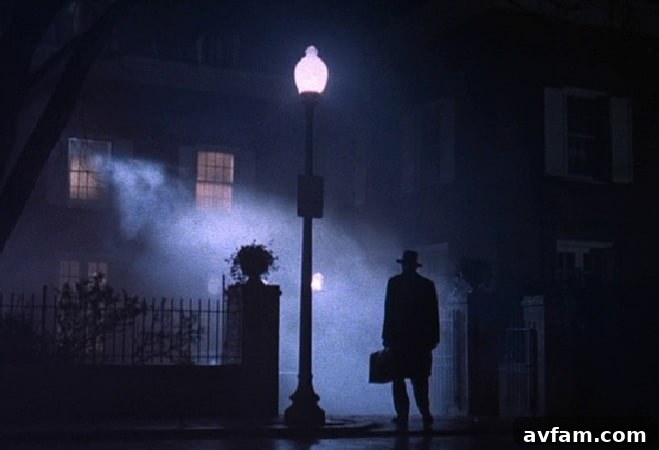
While much of the horror in “The Exorcist” stems from the visceral torment of young Regan MacNeil, the Georgetown home where the possession unfolds is equally integral to the film’s chilling power. Initially, it appears to be an elegant, comfortable residence, a symbol of domestic tranquility. However, as Satan’s grip tightens on Regan, the house itself transforms into a claustrophobic cage, its once inviting rooms becoming cold, foreboding spaces blanketed by a thick layer of silence, punctuated only by the horrifying guttural sounds emanating from Regan’s bedroom. The film cleverly uses the contrast between the stately exterior and the escalating inferno within. And who could ever forget the terrifyingly steep flight of outdoor stairs adjacent to the house, famously dubbed “The Exorcist Steps”? These steps become the gruesome stage for one of cinema’s most shocking moments, solidifying the house’s surroundings as a location of profound dread. This house isn’t just a setting; it’s a witness, an accomplice, and a prison to the ultimate battle between good and evil.
The Blair Witch Project (1999)
Unlike other entries on this list where the house is a constant presence, “The Blair Witch Project” builds its terror in the desolate, foreboding Black Hills Forest. Yet, the crumbling, isolated house that appears in the film’s chilling climax is arguably one of the most impactful and terrifying structures in horror cinema history. After days of relentless psychological torment and being relentlessly stalked by an unseen force, the students stumble upon this derelict structure, a beacon of horrifying finality. Its dilapidated state, dark corners, and stone-walled basement instantly evoke a sense of ancient evil and unimaginable suffering. The final scene, set within its oppressive walls, particularly in the basement, where the camera drops and the horrific “corner scene” unfolds, has left an indelible mark on an entire generation of viewers. To this day, the sheer psychological dread associated with basements, especially those with rough, stone walls, is largely thanks to the terrifying legacy of this seemingly unremarkable house and its role in this groundbreaking found-footage mockumentary.
Thir13en Ghosts (2001)
“Thir13en Ghosts” presents a uniquely modern take on the haunted house trope, featuring a sprawling, ultra-modern mansion known as the “Glass House.” This architectural marvel, constructed almost entirely of glass and designed with intricate, constantly shifting mechanisms, is less a home and more a complex, sinister machine. When a family inherits this seemingly luxurious abode, they quickly discover its true, terrifying purpose: it’s a prison designed to trap and contain a collection of malevolent spirits. The house’s elaborate and transparent design, with its labyrinthine sliding walls, rotating sections, and hidden rooms inscribed with Latin spells, becomes eerily clear as a sinister ghost-powered device is activated. The beauty and sleekness of its design are a stark contrast to the ancient evils it harbors, transforming from a marvel of engineering into a deadly, transparent labyrinth. It’s a testament to how a house’s design can be weaponized, turning a potential dream home into an inescapable, ghostly death trap, proving that even modern masterpieces aren’t immune to infestations of evil spirits.
The Shining (1980)
The Overlook Hotel in Stanley Kubrick’s “The Shining” is arguably the most iconic and chilling hotel in cinematic history, a character as central and malevolent as Jack Torrance himself. Its isolated grandeur, imposing architecture, and sprawling interiors convey both majesty and immense dread. Set high in the Colorado Rockies, the Overlook is a place of immense beauty that slowly reveals its sinister, sentient nature, consuming all who dare to inhabit it during the long, lonely winter. From the eerie emptiness of its vast ballrooms and corridors to the infamous Room 237, the hotel exudes a palpable sense of history and horror. The visually stunning yet psychologically disorienting hedge maze, the river of blood gushing from the elevator, and the unsettling presence of the Grady twins all contribute to the hotel’s legendary status. The Overlook doesn’t just contain ghosts; it *is* haunted, a living, breathing entity that feeds on isolation and despair, driving its caretaker mad and leaving an indelible mark on the landscape of horror cinema.
Poltergeist (1982)
In “Poltergeist,” the Freeling family’s suburban dream home quickly morphs into a full-blown nightmare, proving that horror isn’t confined to old mansions or desolate locations; it can invade the most pristine, modern subdivisions. The house in Cuesta Verde, built over an ancient burial ground, initially appears as the epitome of American suburban comfort and happiness. However, it soon becomes a terrifying nexus for malevolent spirits, turning everyday objects and spaces into sources of profound fear. The television static that opens a portal, the moving furniture, the spectral tree that attacks, and the infamous clown doll are all manifestations of the house’s angry, spectral inhabitants. This film masterfully exploits the fear of having one’s safe haven violated, depicting the home as a fragile shield against unseen forces. The Freeling house stands as a potent reminder that evil can lurk beneath the surface of even the most idyllic settings, transforming a symbol of security into a terrifying, otherworldly battleground.
Psycho (1960)
Alfred Hitchcock’s “Psycho” gives us not one, but two iconic horror structures: the Bates Motel and the looming Victorian house perched menacingly above it. The motel, seemingly innocuous and functional, is merely a front, a stage for Norman Bates’s disturbed existence. It’s in the shadowy, gothic house where the true horror resides. The architecture itself, with its steep gables and shadowy windows, suggests a hidden history and a decaying psychological state. It’s a house that feels alive, almost breathing secrets and insanity. The famous shower scene, while set in the motel, is inextricably linked to the house’s influence, as the true horror is orchestrated by the twisted mind dwelling within the Victorian edifice. The house isn’t just a home for Norman and his “mother”; it’s a mausoleum of repressed desires, a prison for a fractured personality, and a silent witness to unimaginable depravity. Its lasting image, isolated and forbidding on the hill, remains a potent symbol of psychological horror and the dark secrets that can fester behind seemingly ordinary facades.
The Conjuring (2013)
Based on the alleged true experiences of the Perron family, “The Conjuring” introduces us to a classic haunted farmhouse that embodies every trope of supernatural terror, yet executes them with chilling effectiveness. The isolated, old Rhode Island farmhouse is presented as a quintessential haunted location – creaky floorboards, dark attics, a foreboding well, and a palpable sense of dread clinging to every room. From the moment the Perron family moves in, the house reveals its insidious nature, beginning with subtle disturbances that escalate into full-blown demonic possession. The film expertly uses the house’s architecture and rural isolation to heighten the terror, making it feel like an inescapable cage for its tormented inhabitants. The chilling hide-and-clap game, the terrifying discovery in the cellar, and the harrowing exorcism sequence all occur within its walls, turning a seemingly innocent dwelling into a battleground for a family’s soul. The Perron farmhouse perfectly illustrates how a house can be both a sanctuary and the ultimate source of terror, cementing its place as a modern classic in haunted house cinema.
This journey through the most terrifying houses in horror cinema barely scratches the surface of iconic haunted abodes, but each one on this list has undeniably etched itself into our collective nightmares. Whether they are grand hotels, suburban family homes, or dilapidated shacks in the woods, these structures prove that a truly terrifying house can elevate a horror movie from merely scary to profoundly unsettling. Their walls hold secrets, their foundations vibrate with ancient evils, and their very presence can make us question the safety of our own homes. As Halloween approaches, why not gather your favorite snacks, settle in, and revisit these chilling residences? I’m dying to know (pun intended!) which haunted houses or creepy cinematic dwellings send shivers down your spine. Let me know your favorite spooky residences in the comments section below, and who knows, your suggestion might just inspire my all-day movie marathon this Halloween!